

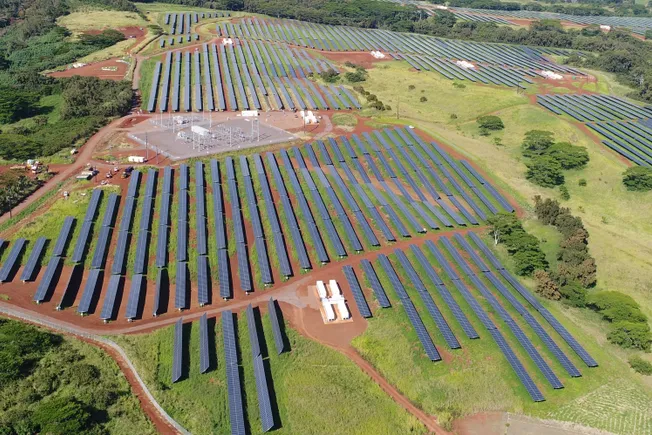
The U.S. Energy Information Administration (EIA) has announced a significant increase in solar energy production, projecting a 35% rise in 2025 and an additional 18% in 2026. This information was included in their latest short-term energy outlook published recently. Alongside the growth in renewable energy sources, the EIA anticipates an increase in electricity prices, a slight rise in demand, and a temporary boost in coal generation.
The EIA had postponed the release of its monthly report by two days to update its models in response to recent market trends. They noted that rising natural gas costs compared to last year are expected to drive wholesale power prices higher. They predict that the average wholesale power price across 11 regions will reach $45 per megawatt-hour in 2025, marking a 19% increase from the average in 2024.
The report also indicates that residential electricity prices in the U.S. are anticipated to average 17 cents per kilowatt-hour (kWh) in 2025, rising to 17.6 cents/kWh in 2026. This is up from an average of 16 cents/kWh in 2023.
In terms of overall electricity generation, the EIA forecasts that it will increase to 4,430 billion kWh by 2026, up from 4,410 billion kWh in 2025 and 4,180 billion kWh in 2023.
In a separate development, President Donald Trump signed executive orders aimed at supporting the coal industry. Despite this, the EIA projects a continuing decline in U.S. coal production, predicting it will drop from 580 million short tons in 2023 to 470 million short tons by 2026. However, there is an expected temporary rise in coal production this year, climbing close to 490 million short tons due to stronger performance in March.
While the EIA predicts a 4% increase in coal consumption this year compared to 2024, they also expect a 4% drop in production. Consequently, coal inventories at electric power plants in the U.S. are expected to fall 19% by the end of 2025.
Despite these declines, the EIA has adjusted its expectations regarding year-end coal stockpiles upwards, citing an anticipated increase in coal production for this year. Solar energy capacity is set to expand significantly, going from 91 GW in 2023 to 153 GW in 2025 and 182 GW in 2026. Additionally, domestic wind energy capacity is forecasted to rise from 147 GW to 173 GW in the same period.
The EIA also highlighted that exports will be a major driver of natural gas demand growth, projecting a 4% rise in combined domestic use and exports in 2025. They expect an 18% surge in natural gas exports through pipelines and as liquefied natural gas (LNG).
Demand for natural gas is expected to be bolstered by cooler weather in early 2025 compared to the previous year, resulting in a 9% annual increase in consumption for heating purposes. The share of natural gas in U.S. electricity generation is predicted to remain steady at 40% in both 2025 and 2026, down from 42% in 2023 and 2024.