

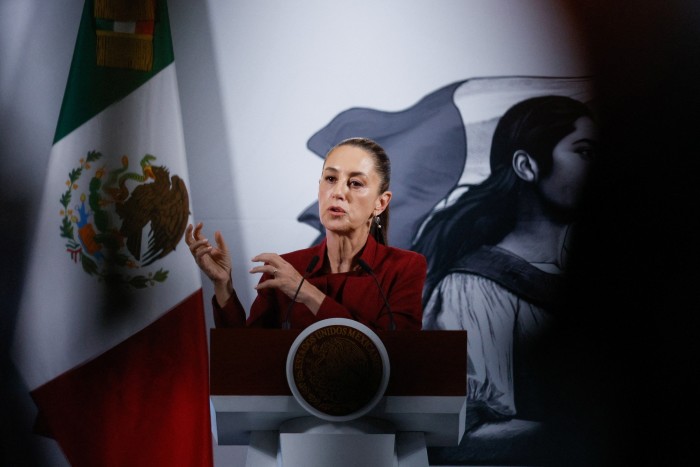
Mexico is currently exploring the possibility of increasing fracking activities as concerns grow over its reliance on natural gas from the United States. According to four executives involved in discussions, the Mexican government is in talks with private sector companies regarding this potential shift. Mexico depends on the U.S. for around 70% of its gas supply, making it vulnerable to any drastic changes in U.S. policies.
The consideration of fracking marks a significant shift from previous policies in President Claudia Sheinbaum’s party, which has traditionally been cautious about the practice due to environmental concerns. As a former climate scientist, Sheinbaum has directed officials to look into fracking to help boost Mexico’s energy independence. Discussions have also included evaluating the development of Mexico’s shale gas resources.
While fracking is legally allowed in Mexico, its usage is currently minimal. Previous efforts under former President Enrique Peña Nieto to contract fracking were quickly halted by the current administration led by Sheinbaum’s predecessor, Andrés Manuel López Obrador.
The potential move towards fracking aligns with a broader global trend where countries are trying to reduce their dependence on U.S. trade. Mexico has significant shale gas reserves, being ranked sixth in the world in terms of recoverable resources. Utilizing these reserves could not only enhance energy independence but also provide a much-needed boost to Mexico’s economy at a time when it faces recession risks.
Although there is interest from companies to invest, discussions within the government remain in the early stages, and concrete policy changes may take time to implement. This change in direction could signify a new era for Mexico’s energy sector, with investment likely occurring through a new mixed public-private partnership model recently approved by Sheinbaum.
At a recent event, Sheinbaum outlined her intention to raise natural gas production in Mexico from 3.8 billion cubic feet per day to 5 billion cubic feet by 2030 using sustainable methods. There’s also been public remarks from Victor Padilla, CEO of the state-owned oil company Pemex, hinting at the government’s interest in revitalizing fracking to find out what energy resources exist in the country’s subsoil.
Some of Mexico’s shale reserves are located in the Burgos Basin, close to the U.S. border, connecting to the vast Eagle Ford shale basin in Texas. Proponents argue that fracking could help reverse a long-standing decline in the oil and gas sector, which has suffered from mismanagement and debt issues, making Pemex one of the most indebted oil companies in the world.
The signals emanating from this policy shift illustrate Sheinbaum’s struggle to balance her goals of energy independence, she also aims to strengthen Pemex while increasing the share of clean energy sources. Although López Obrador had proposed a constitutional ban on fracking, which did not pass, current circumstances reflect a changing environment where trade protectionism and economic pressures are at play.
Sheinbaum’s administration is under pressure to secure more revenue, especially after significant spending by López Obrador’s government left a budget deficit. Fracking’s revival poses risks for her reputation as a climate-focused leader and could create backlash from environmental advocates within her party. As Mexico continues to navigate these complex issues, the balance between energy policy and environmental concerns remains a crucial challenge.