

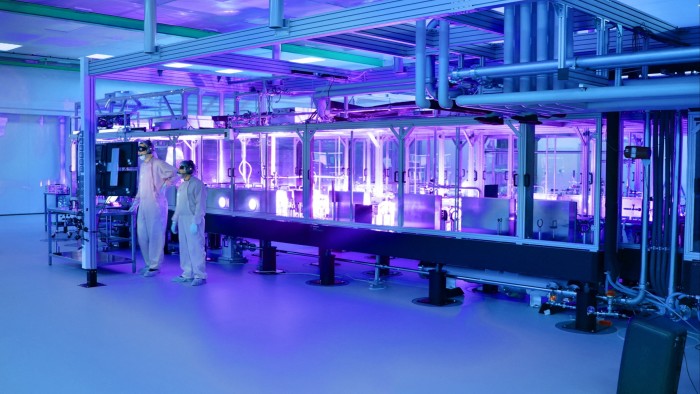
Marvel Fusion, a start-up in the fusion energy sector, has successfully secured €113 million in fresh funding. This advancement comes as Germany intensifies its focus on developing zero-carbon energy solutions through atom fusion.
The Munich-based company completed a Series B funding round, attracting investments from notable players including the venture branch of Swedish private equity group EQT, Siemens Energy, and the European Innovation Council. Moritz von der Linden, the founder, stated that this funding marks one of the largest commitments to date in Europe’s developing fusion industry, especially as the region strives to keep pace with the U.S. and China.
Fusion, a process where hydrogen isotopes are heated to extreme temperatures causing them to fuse and release energy, has intrigued scientists since the 1950s. Unlike traditional nuclear fission—which splits atoms and creates long-lasting waste—fusion holds the promise of cleaner energy.
However, even with extensive research, many experts assert that practical fusion power plants are still decades away from reality. Friedrich Merz, Germany’s chancellor-in-waiting, has actively supported fusion research, emphasizing the importance of Europe not allowing China to dominate this crucial field. He has suggested that Germany should take the lead by hosting the first fusion reactor integrated with the energy grid.
Despite Germany and the UK’s historical roles in fusion research, they currently have fewer private start-ups pursuing fusion compared to the U.S. Much of the current investment has been directed toward magnetic confinement technology, which uses large magnets to contain hydrogen isotopes at extreme temperatures.
In contrast, Marvel Fusion is developing a different approach called inertial confinement, where lasers are aimed at a small hydrogen capsule to trigger an implosion. Interest in this method surged after a significant achievement last December by scientists at the National Ignition Facility in the U.S., who managed to generate more energy from a fusion reaction than they used.
Von der Linden expressed optimism about Marvel Fusion’s position in this competitive landscape, stating that they are now the best-funded laser fusion company globally. Siemens Energy, which has made a modest investment, praised the progress being made by this European firm.
While U.S. companies focusing on magnetic confinement have attracted much larger investments—like Commonwealth Fusion Systems with $1.8 billion in funding—Von der Linden believes their technology could provide power at a reduced cost. The company’s goal is to construct a prototype facility by 2032 and a commercial fusion power plant by 2036.
To be feasible commercially, Von der Linden noted that fusion power would need to supply electricity at or below five U.S. cents per kilowatt hour, a target he believes their approach can achieve.