

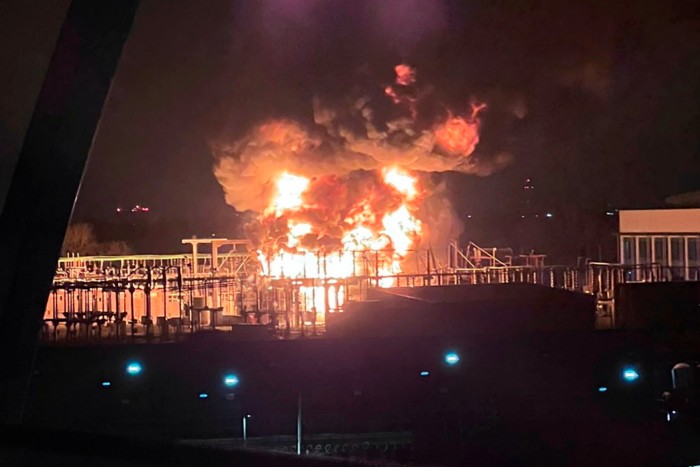
Firefighters responded to a significant blaze at the North Hyde power substation in Hayes, west London, late Thursday night around 11:20 PM. The substation is located less than two miles from Heathrow Airport.
As a result of the fire, Heathrow, one of the busiest airports in the world, was forced to halt all flights. Incoming aircraft, including those from distant locations such as New Delhi and Los Angeles, had to turn around as the chaos unfolded.
Willie Walsh, the director-general of the International Air Transport Association and former British Airways CEO, raised concerns about the heavy reliance on a single power source for such important infrastructure. He criticized the airport’s planning, questioning how such critical systems can be so vulnerable.
The fire’s cause is still under investigation, but it was intensified by approximately 25,000 liters of cooling oil in the substation’s transformer. This fierce blaze severely damaged backup transformers, leading to the complete shutdown of the electricity supply necessary to operate terminals 2 and 4 at Heathrow and to power runway lights.
Although Heathrow’s backup diesel generators operated correctly, they are designed only to provide basic functions, like landing planes and evacuating passengers, rather than to fully support airport operations.
Shortly after 2 PM on Friday, engineers from National Grid and Scottish and Southern Electricity Networks successfully reconfigured the substation to restore power to the airport. It took several hours for Heathrow to confirm that the power supply was stable and to ensure that all systems were functioning properly. The airport announced it would reopen around 4 PM, with the first flights expected to depart by 7 PM.
Heathrow is now under pressure to explain how it became so vulnerable to a single point of failure. Infrastructure specialist Dieter Helm from Oxford University commented that this incident is a significant reminder of the fragility in critical systems and their interdependence. He expressed the need for increased resilience within the energy infrastructure.
Heathrow’s CEO, Thomas Woldbye, defended the airport’s contingency planning and pointed out that it can still operate using power from its other substations. However, he also noted that switching systems over to the alternate power supply requires time and effort.
Due to its high debt levels of over £19 billion, Heathrow has faced ongoing scrutiny regarding its financial management and investments in infrastructure. Experts suggest that the incident highlights the need for more substantial governmental oversight of the UK’s critical infrastructure, much of which is privately owned.
This fire incident comes as the UK seeks to transition toward more electric-based systems, such as electric vehicles and renewable energy sources, emphasizing the pressing need for substantial infrastructure upgrades to meet growing energy demands.
As frustrations mount, passengers delayed worldwide are left wondering when they will be able to fly again. One traveler expressed her disappointment, commenting on the rising costs of meals in nearby hotels amid the uncertainty.