

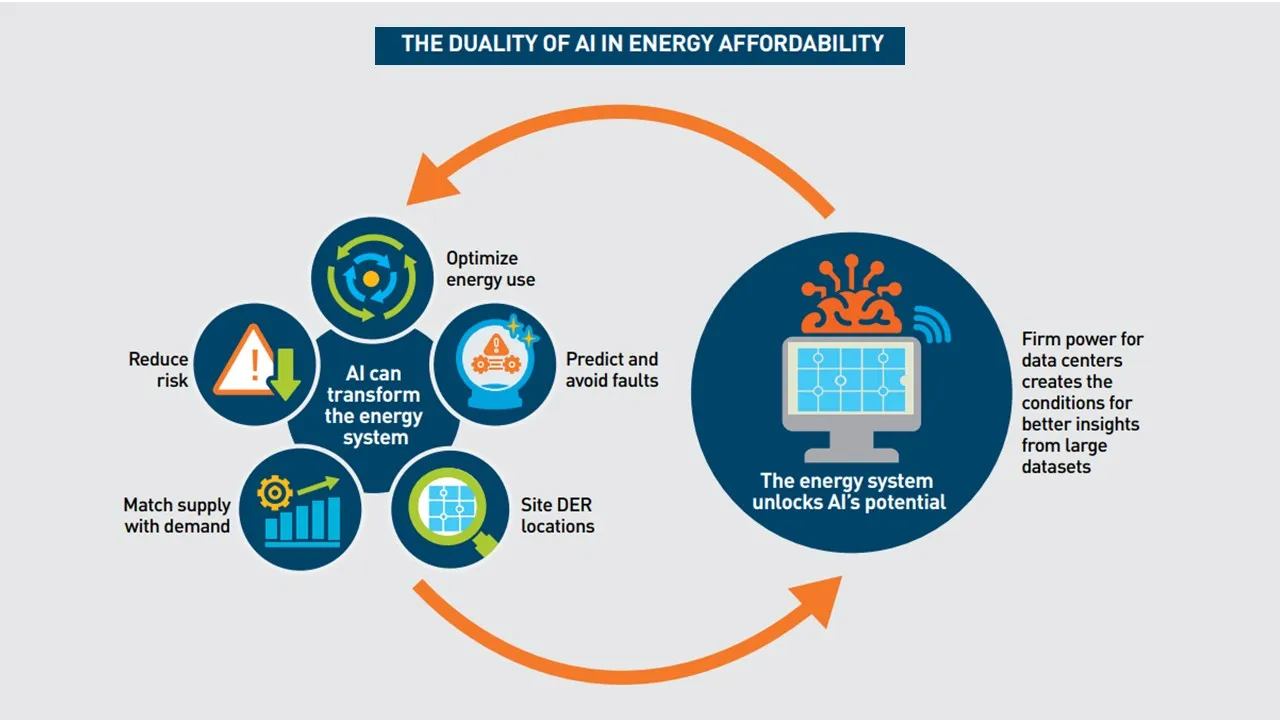
Utilities are increasingly finding innovative ways to use artificial intelligence (AI) and machine learning (ML) to tackle reliability challenges as the demand for electricity grows. A paper from the Electric Power Research Institute (EPRI) highlights a surge in interest around generative AI models, which has led to vast financial commitments from the U.S. and Europe. This shift is prompting utility companies to explore new opportunities in AI technology.
Jeremy Renshaw, Executive Director at EPRI, noted that even utility professionals who were once doubtful about AI are now embracing technologies like cloud computing and drones. The rapid adoption of these tools could lead to what seems impossible today becoming standard practice in the near future.
However, there are concerns about the reliance on AI/ML systems. Some experts worry that these algorithms might make decisions without human oversight, potentially causing the reliability issues they aim to prevent. Marc Spieler, Senior Managing Director at NVIDIA, emphasized the importance of integrating AI models with a utility’s existing knowledge. He believes that AI can enhance decision-making by providing quicker access to relevant data while keeping humans involved in the process.
Utilities are already actively applying AI and ML in various areas such as designing nuclear power plants and optimizing electric vehicle (EV) charging. Yet, the challenge remains for utilities and regulators to strike a balance between making data accessible for AI systems while ensuring its security.
In cybersecurity, AI/ML algorithms are improving the ability to detect cyber threats. Companies like Checkpoint Software are collaborating with standards organizations to enhance security for consumer devices, particularly during software updates. Other applications include forecasting market prices by analyzing weather, demand, and available power generation.
Companies such as Amperon have been utilizing these algorithms for weather and demand forecasting since 2018 and have noted significant improvements in their accuracy. Furthermore, Hitachi Energy’s AI forecasting tool has reportedly increased price prediction accuracy by 20%.
AI/ML technology is also becoming crucial in wildfire risk management, enabling utilities to assess risks more effectively by analyzing more variables than a human could process. Additionally, recent advancements have led to the use of robotics in solar construction, significantly reducing the time it takes to reprogram machines for specific tasks.
As the complexities of managing diverse energy sources grow, utilities must look to AI driven capabilities for solutions. A report from Pacific Gas and Electric (PG&E) outlines that without enough flexibility in the power system, reliability and safety could decline while operational costs could rise. AI/ML offers enhanced immediate responses and long-term planning solutions.
PG&E predicts their electricity use could double in the coming years, but with the help of AI/ML technology, they believe they can control peak loads effectively. Access to AI/ML can help utilities manage a plethora of operational scenarios, optimizing their existing data for better efficiency.
Demonstrations of AI in practical scenarios have proven promising. For instance, Utilidata’s Karman software platform, embedded in smart meters, reads distribution system data at a high frequency to optimize electricity use in real-time. Implementations have resulted in a notable reduction in service calls related to high bill complaints by streamlining how companies understand usage spikes.
Furthermore, AI/ML tools are also aiding in making nuclear power plants safer and more cost-effective. Companies are using advanced algorithms to meet regulatory standards while improving operational efficiency.
However, to fully harness these technologies, utilities must invest in hardware, software, and a mindset focused on customer engagement and operational integration. They need to establish a communication and data infrastructure that supports real-time analytics. Striking a balance between data protection and the need for data access remains a challenge as well.
With utilities beginning penetration testing on their systems and even creating committees to oversee data usage, the industry is recognizing the importance of cybersecurity alongside the growth of AI applications. Employing methods like federated learning can help protect sensitive information while training algorithms, although some believe that using larger datasets may be the more effective approach.
In conclusion, the key for utilities lies in gathering high-quality data and utilizing it properly. By embracing these technologies, they can improve their operations and ultimately enhance service to their customers.