

The latest developments in the oil and gas sector have investors raising eyebrows. Despite expectations of growth fueled by government policies promoting fossil fuel expansion, shares in U.S. oil companies have not performed well lately. The Dow Jones U.S. Oil and Gas index has seen a decline of 1.2% over the past year, in stark contrast to an 11.3% increase in the S&P 500.
Concerns in this sector are warranted, as a recent study suggests that significant declines could be on the horizon.
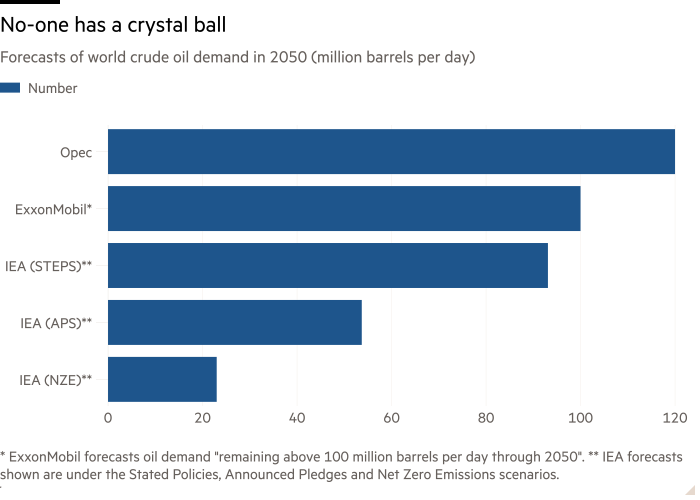
A report from OPEC forecasts that global oil consumption will increase to 120 million barrels per day by 2050, up from 104 million currently. Major oil companies like ExxonMobil, BP, and Equinor are increasing their investments, anticipating steady demand. However, the possibility that they may be miscalculating the future demand for oil cannot be ignored, especially in a landscape increasingly focused on reducing reliance on fossil fuels.
A new study by the UK Sustainable Investment and Finance Association, in collaboration with analysis firm Trex, highlights that under a scenario where governments meet their climate goals, global fossil fuel asset valuations could take a major hit. Specifically, it predicts up to $2.3 trillion in asset write-downs and financial losses by 2040 due to resources being left untapped, leading to lower prices.
The biggest losses would likely impact countries such as the U.S., Russia, and China, with projected losses of $546 billion, $402 billion, and $184 billion, respectively. The UK, though smaller in the global fossil fuel picture, is projected to suffer losses of $141 billion, equating to over £2,000 per citizen. The UK pension fund sector could bear a significant part of these losses, estimated at £15.2 billion.
This discussion assumes that governments will meet their emission targets, a point of contention, particularly following recent political shifts in the U.S. The International Energy Agency (IEA) outlines a less ambitious scenario where even without serious climate commitment, stranded assets could reach $872 billion, with the UK responsible for $49 billion of that.
The assumptions made by OPEC around continued strong oil demand also appear somewhat optimistic, especially with the global shift towards electric vehicles. Sales of electric vehicles in China are anticipated to surpass those of conventional combustion-engine cars this year, while other countries are gradually following suit. Traditional petrol-based transportation remains a significant source of oil demand, but the numbers indicate a potential decline by 2030.
For investors, the question now is one of timing. Despite recent poor performance, those invested heavily in the sector over the past five years have still seen returns, with the Dow Jones U.S. Oil and Gas index rising by 105% compared to a 94% increase in the S&P 500. However, a clear signal that oil demand is decreasing could lead to a swift reassessment of asset values.
As Willemijn Verdegaal, co-CEO at Trex, emphasizes, the transition away from fossil fuels is already underway, whether new policies are implemented or not. Investors in fossil fuel companies must reflect on the risk involved and whether they are ready for the potential fallout when the market shifts.