

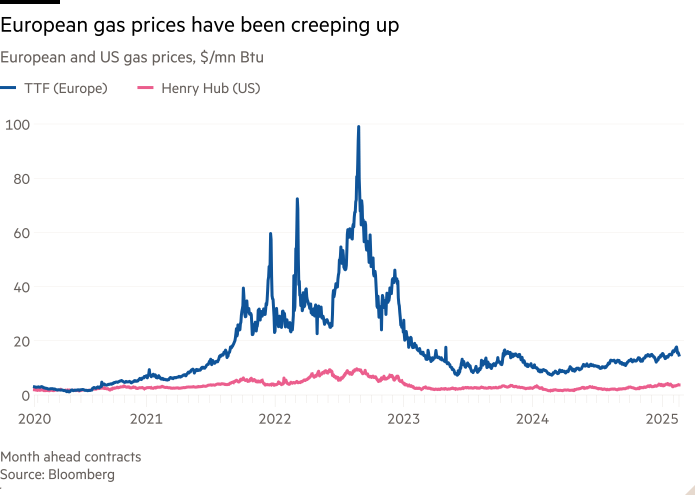
Europe’s natural gas sector is experiencing some changes as it tries to adjust after significant disruptions from Russia’s invasion of Ukraine in 2022. The continent has worked hard to make up for a decrease in Russian gas imports by seeking out more liquefied natural gas (LNG) from places like the United States, while also reducing its overall gas consumption.
However, recently, there have been some unexpected developments. Gas storage levels are lower than what is typical for this time of year, leading to a spike in prices that reached a two-year high in early February. Prices have since dropped by nearly 20% as European nations contemplate easing requirements for storing gas over the summer. With discussions about potentially ending the war in Ukraine underway, there are even rumors about the possibility of some Russian gas imports returning.
This situation reflects a growing demand for gas in Europe, which has not completely disappeared. In fact, European gas demand is about 100 billion cubic meters less than it was in 2021, roughly 18% lower than pre-crisis levels. Some of this drop is due to a shift toward renewable energy, while a portion of it stems from reduced industrial use as businesses lost market share. A bit of good fortune, including milder winters, also helped lessen demand.
Data from the International Energy Agency shows that gas demand actually increased by 9% in the last quarter, driven by colder weather and some economic recovery. This suggests that Europe’s balance of gas supply and demand remains fragile, contributing to the recent rise in prices.
Despite the occasional spikes in prices, European leaders should be careful not to return to their previous reliance on Russian gas. While there are ongoing delays in LNG projects that will eventually enhance supply, the U.S. may also prefer to maintain a competitive market rather than flooding it. This indicates that Europe might be better off continuing its current strategy.
However, without long-term changes to its energy mix that allows industries to operate effectively, Europe may find it hard to completely ignore the appeal of Russian gas. Projects like Arctic LNG 2 have the potential to bring significant additional supplies in the future, further complicating the energy landscape for Europe.