

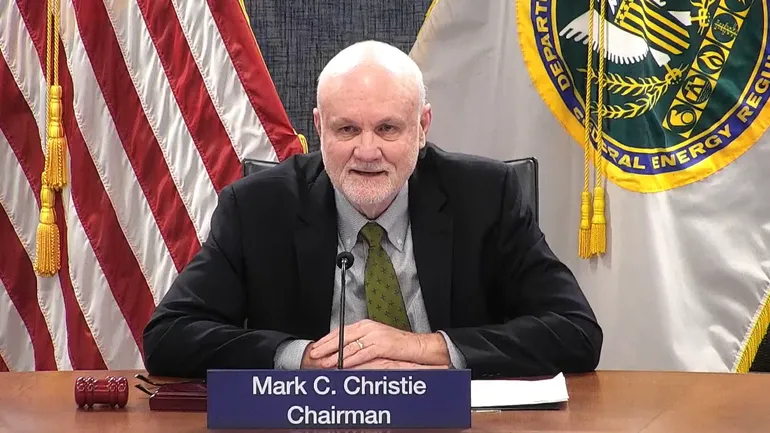
A recent executive order from the White House sets new requirements for the Federal Energy Regulatory Commission (FERC) and other independent bodies. However, FERC Chairman Mark Christie points out that many of the actions outlined in the order are already standard practices for the commission.
During a media briefing on Thursday, Christie explained that the order essentially consolidates previous practices into a single document. He noted that FERC is already required to share its budget and strategic plans with the Office of Management and Budget (OMB) for review, and this has been a longstanding requirement.
Christie emphasized that although the executive order includes new guidelines, he seeks clarification on specific elements, especially regarding potential oversight of ongoing cases at FERC, which handles over 1,000 cases each year.
While the OMB is likely focused on significant regulations within agencies, Christie’s concern is whether standard procedures would be affected under the new executive order. He confirmed that FERC will seek further details as they navigate the implications of the order.
The activities of FERC are largely determined by various federal laws, including the Federal Power Act and the Natural Gas Act. Christie stated, “At the end of the day, we follow the law,” underscoring the commission’s commitment to its foundational statutes.
Notably, the executive order has a clause affirming that it should not influence existing laws or the authority of agencies, reaffirming FERC’s establishment under the Department of Energy Organization Act.
Christie also affirmed that FERC commissioners do not discuss ongoing contested cases due to legal restrictions, but they do engage in topics like grid reliability with officials from other departments, which is deemed appropriate.
He highlighted that any comments made by the administration during FERC proceedings must be formally recorded and cannot be simply conveyed through informal channels.
In reflecting on FERC’s critical mission to maintain grid reliability while managing costs, Christie noted that this aligns with the goals of the previous Trump administration.
When asked about a president’s power to influence FERC through the agency chair’s removal, Christie acknowledged that Congress grants the president this authority, which could be executed with minimal paperwork.
FERC faces challenges regarding special interests in its decision-making processes. Christie pointed out that the potential for “regulatory capture,” where special interests could unduly influence FERC, remains a significant concern. He stressed the need for the commission to prioritize public interests over special interests.
Christie revealed that he has considered establishing a rule requiring transparency for private meetings between commissioners and lobbyists. Lastly, he indicated that the executive order’s provision aimed at aligning legal interpretations with the president’s stance should not hinder a FERC commissioner’s ability to express dissent. This provision is likely reserved for major cases that could reach the U.S. Supreme Court.