

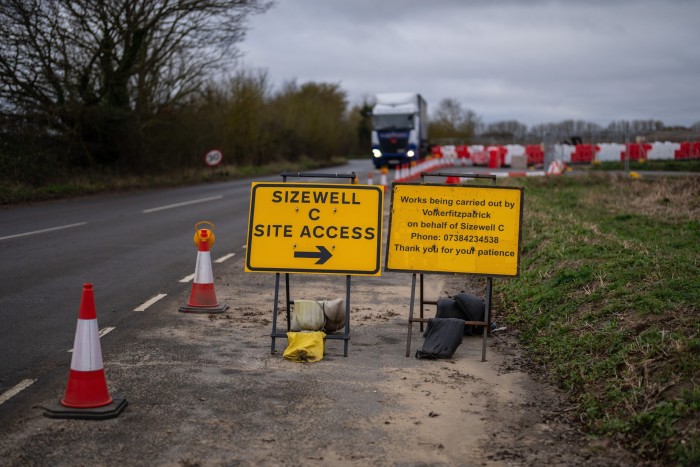
The construction site located behind Sizewell beach in England’s East Anglian region is bustling with activity. Here, two nuclear reactors are set to begin operations by the middle of the next decade, providing enough electricity to power around six million homes.
What makes this site remarkable is not just its size, but also that it serves as a near replica of another facility located 280 miles away at Hinkley Point C. Construction for Hinkley Point C started in 2016, a full eight years ahead of the Sizewell C project.
Building identical plants forms part of a larger strategy to solve persistent problems in the nuclear energy industry, particularly issues related to high costs and long delays. Academic Bent Flyvbjerg has termed this challenge as “negative learning,” pointing out that despite gaining experience, costs and construction timelines in the nuclear sector tend to increase rather than decrease.
To tackle this, the industry is looking at constructing replica reactors to bring consistency and familiarity to the building process. “The idea is to replicate tried-and-tested designs,” says Flyvbjerg.
Many governmental leaders believe that nuclear power is critical for a successful energy transition, as it can generate significant amounts of power with minimal carbon emissions. Fatih Birol, the executive director of the International Energy Agency, has called for a renewed focus on nuclear energy, noting that 63 reactors are currently under construction globally—one of the highest numbers seen in three decades.
However, overcoming historical challenges will be essential. According to the IEA, many nuclear projects in Europe and the U.S. have run significantly over budget and behind schedule, with average delays of eight years and costs ballooning to two-and-a-half times initial estimates.
Flyvbjerg notes that when comparing nuclear power projects to other major infrastructure undertakings, nuclear plants are often more costly, slower, and more complex. Despite this, there is optimism that adopting standard designs like that of Sizewell C could pave the way for greater efficiency.
The goal is ambitious—a coalition of 31 countries aims to triple global nuclear energy capacity by 2050. The nuclear sector is also generating interest as a power source for data centers, offering various applications such as heating, chemical production, and even hydrogen generation.
Some countries, including South Korea, China, and the UAE, have shown greater success in controlling costs and completion times compared to projects in Europe and North America. For instance, South Korea’s recent projects, Saeul 1 and 2, were completed only slightly over budget and with minimal delays.
Birol acknowledges that the situation is varied. He highlights the lack of a continuous process for building nuclear plants in Europe and the U.S. as a significant issue.
Tom Burke, founder of the clean energy consultancy E3G, expresses skepticism regarding claims of efficiency, stating the credibility of reported success stories is questionable, especially when looking at the mixed records of recent projects in countries like Finland and the U.S.
The challenges persist for major players like EDF, the French utility company behind Sizewell C, which has faced setbacks and delays on its recent projects.
Sizewell C, originally expected to cost £18 billion, is now anticipated to reach £40 billion, while Hinkley Point C’s costs have soared to an estimated £46 billion. EDF’s chief executive, Luc Rémont, emphasized the need for a consistent approach across Europe to enhance operational efficiency.
In efforts to avoid the mistakes of the past, Rémont advocates for using the same design across multiple projects. This approach aims not only to reduce costs but also to streamline the construction process.
Despite these developments, many experts remain cautious. Concerns about increased regulations following past nuclear accidents add layers of complexity and potential costs.
In summary, while there is a strong push towards standardization in nuclear power construction, the industry still faces significant hurdles in terms of costs, timelines, and regulatory challenges.