

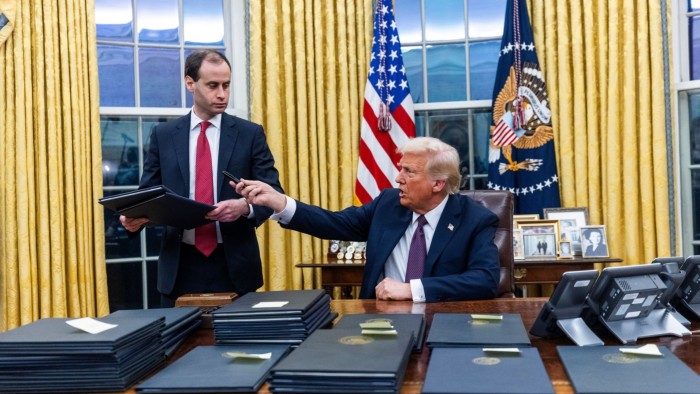
Donald Trump’s recent return to the White House has raised concerns among U.S. investors regarding the future of federal infrastructure funding, estimated to exceed $300 billion. Following his inauguration, Trump moved swiftly to roll back many of President Joe Biden’s climate-focused policies.
On his first day in office, Trump signed multiple executive orders that halted funding to manufacturers and infrastructure developers, effectively overturning key provisions of Biden’s major legislative efforts, including the Inflation Reduction Act and a bipartisan infrastructure law. These actions impact nearly $50 billion in already approved loans by the Department of Energy, along with an additional $280 billion in loan requests still under consideration.
In an executive order titled “Unleash American Energy,” Trump’s administration instructed all agencies to stop disbursing funds that had been allocated through these acts. This freeze places significant loans—like the $9 billion conditional loan to DTE Energy in Michigan and a $3.5 billion loan to PacifiCorp in Oregon—into jeopardy.
Investors have expressed deep concern about the implications of these orders, especially regarding access to federal funding for electric vehicle and battery production. Experts in the field note that these measures may create substantial hurdles for projects that were counting on this funding, potentially jeopardizing ongoing investments.
The infrastructure law aimed to invest $1.2 trillion in upgrading the nation’s transportation systems, while the Inflation Reduction Act was set to provide $370 billion in tax incentives, grants, and loans, introducing extensive funding opportunities through the Department of Energy.
However, with Trump’s actions, investors anticipate that future funding, worth around $300 billion primarily sourced from the infrastructure law, may also be frozen indefinitely. Those relying on these financial advancements to support clean energy initiatives could face major obstacles, limiting their ability to secure necessary capital.
While the loans are greatly affected by these changes, the tax credits established by the Inflation Reduction Act still appear safe, having already stimulated over $130 billion in investments since their introduction.
In anticipation of Trump’s return to power, Biden’s team had expedited nearly $50 billion in loan commitments to ensure ongoing progress on clean energy projects. Nonetheless, the looming possibility that Trump could halt new initiatives—including the construction of offshore wind farms and the termination of incentives for electric vehicles—has resulted in a downturn for shares of related companies like Tesla and Rivian.
New project plans have also begun to stall. For example, the Italian company Prysmian Group has announced its decision to abandon a factory project in Massachusetts focused on producing cables for the offshore wind sector. Other companies have already re-evaluated their renewable energy endeavors in the U.S., with German energy firm RWE scaling back its wind project plans.
Experts warn that the atmosphere of unpredictability surrounding investment in U.S. clean energy could create long-term challenges for attracting capital, especially as many offshore wind projects may now face significant delays or cancellation under Trump’s administration.
Additional reporting from various contributors has highlighted the broader implications of these developments on the future of energy in the United States.