

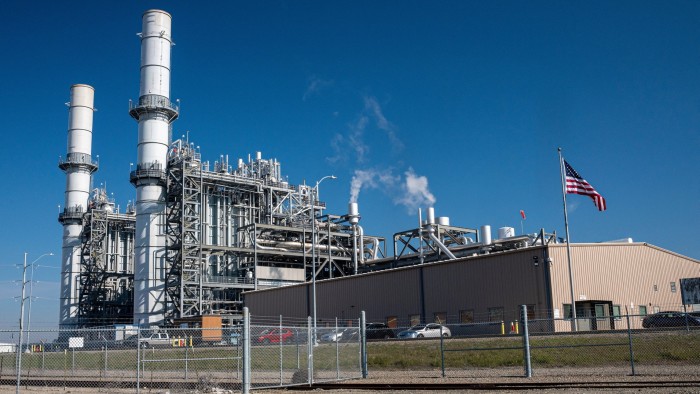
The United States is about to see a significant increase in natural gas power plant construction as major technology companies seek fossil fuels to satisfy the growing electricity demands from artificial intelligence. This surge raises concerns about the country’s climate goals.
Energy consultancy Enverus predicts that by 2030, up to 80 new gas-fired power plants will be established across the U.S., adding 46 gigawatts of capacity. This is comparable to the total electricity supply of Norway and represents nearly a 20% increase from what was added in the past five years.
The construction boom is likely to coincide with the second term of Donald Trump, who has pledged to maintain fossil fuels as an integral part of the U.S. economy. This marks a change from earlier expectations that gas capacity would decline over the next five years.
Corianna Mah, a research analyst at Enverus, noted, “Gas is actually growing faster now, and in the medium term, than ever before.” However, this expansion threatens the Biden administration’s climate goals that aim for a 50-52% reduction in greenhouse gas emissions from 2005 levels by 2030 and a completely carbon-free grid by 2035.
Armond Cohen, executive director of the Clean Air Task Force, an environmental nonprofit, commented, “For natural gas to be part of a decarbonized energy system, its emissions must be reduced as much as possible.”
Last year, U.S. gas power plants emitted over 1 billion tonnes of carbon dioxide, marking a nearly 4% annual increase and the highest level on record according to data from Ember. None of the future gas plants are expected to have carbon capture technology, and while regulations may require such systems for new plants by 2032, these rules could be loosened.
Some analysts, including those from Wood Mackenzie and S&P Global Market Intelligence, suggest that overall U.S. energy capacity could grow even more rapidly than previously thought – by 35% to 66% over the next five years.
This growth in gas facilities comes as the U.S. seeks to compete with China in artificial intelligence development and aims to revive domestic manufacturing, leading to a sharp rise in demand for reliable, affordable electricity.
As the world’s largest natural gas producer, thanks to abundant shale resources, the U.S. has managed to keep gas prices relatively low, even during the energy crises faced by Europe, which has supported a boost in exports.
While renewable energy sources are also increasing, boosted by government subsidies, experts indicate that these sources still fall short in fulfilling the demands of large power consumers. Matt Bulpitt, vice president of power development at Entergy, a southern utility, stated, “Your ability to serve that kind of load reliably is very limited with traditional renewables.”
In December, Entergy announced a $3.2 billion plan to construct three gas plants totaling 2.3 gigawatts to support Meta’s large AI data center, which will become the utility’s biggest customer once operational.
Energy demand in the U.S. has already reached record levels and is expected to increase by another 16% by 2029, as per estimates from Grid Strategies. The Department of Energy predicts that electricity consumption from data centers will triple over the next three years.
According to recent predictions, the outlook for gas-fired generation has shifted dramatically, overturning expectations from just recently, where a net decrease was anticipated from 2025 to 2030.
As companies race to meet this growing demand for gas, some are investing heavily in expanding production capabilities. Bill Newsom, CEO of Mitsubishi Power Americas, revealed plans to invest hundreds of millions to boost manufacturing capacity significantly.
Utility and turbine manufacturer stocks, including Siemens Energy and GE Vernova, have seen significant increases in share value over the past year, and major oil companies like ExxonMobil and Chevron are also developing plants to supply data centers directly.
On a notable note, Constellation Energy recently announced its acquisition of Calpine, the largest independent gas power producer in the U.S., in a $27 billion deal, showcasing the shift within the energy sector.
Texas, Tennessee, and South Carolina are leading this new wave of gas capacity expansion, driven partly by a transition from coal to gas. Bob Warden, managing director at Fortress Investment Group, acknowledged the need for renewables but recognized the time it would take for cleaner energy to become more predominant in the energy landscape.