

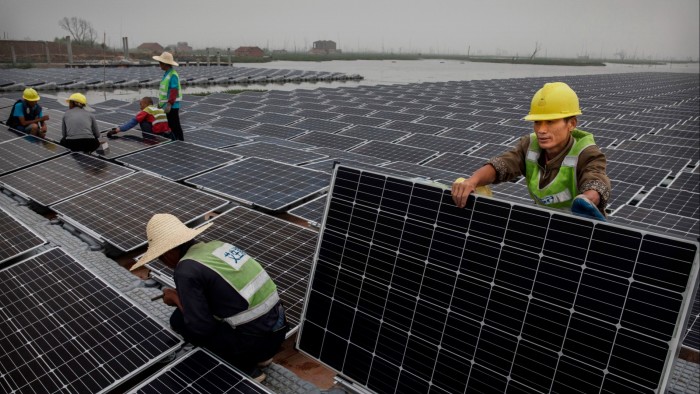
After years of challenges like excess production, low prices, and lack of investor interest, China’s solar industry is showing some signs of bouncing back.
Back in 2010, Europe was the leader in solar panel production, with Germany topping the charts by a significant margin. However, China made a strategic move to enter the market and succeeded beyond expectations.
While China gained a lot of ground against Germany, it also created problems such as overproduction and falling prices. Investors steered clear of this sector because of its uncertain future and poor growth potential, but recent indicators suggest it might be starting to stabilize.
The solar industry has had a notable surplus. In 2022, China’s solar cell production capacity surged to about 1,000 gigawatts, far surpassing the current global demand. If production continues at the same pace, it could exceed projected demand until 2035.
This overproduction has led to an 85% drop in solar panel prices over the last decade. Many Chinese solar companies faced financial difficulties, with about a third reporting losses last year, and some even going bankrupt.
Additionally, changing policies in significant markets, especially in the U.S., add to the uncertainty. The subsidies under President Biden’s Inflation Reduction Act may face challenges depending on the political landscape.
Nonetheless, there are positive developments. Recently, polysilicon prices, essential for solar cells, increased by 2.2%, marking the highest levels since May. Cuts in production and lower inventory are beginning to have a positive effect. Also, the rapid expansion of renewable energy in markets like Southeast Asia and India could reshape the industry.
China is also taking action to boost its own market. As the world’s largest consumer of solar panels, it’s intensifying its installation plans, such as the “Solar Great Wall” project in Inner Mongolia, which aims to convert desert areas into renewable energy hubs, creating a higher demand for solar panels. While relying heavily on government support isn’t a long-term solution, it does help alleviate some of the current pressures.
Investors have long adjusted to this difficult environment, with shares of major companies like JA Solar Technology and JinkoSolar, dropping significantly since their peak in 2022. However, they’ve seen improvement of over 20% in the past six months, indicating that the sector may be nearing a turning point.
As situations evolve, it might just be the right moment for investors to reconsider their positions in this sector.