

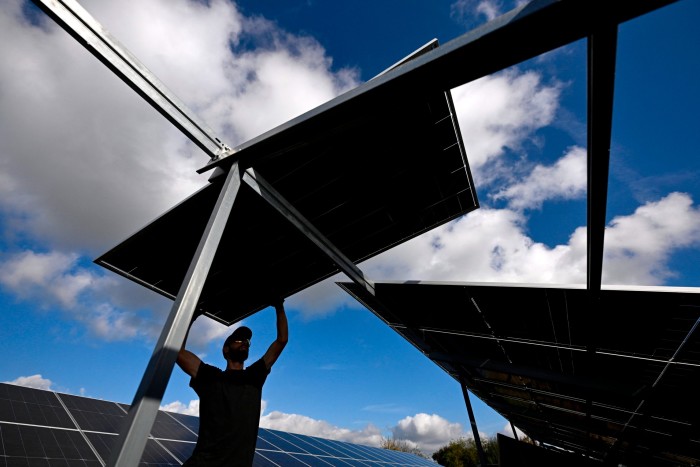
Germany’s residential solar panel industry is currently going through a challenging phase, experiencing significant distress. A decline in consumer interest has led to numerous bankruptcies and layoffs within Europe’s largest market for solar energy.
Many companies involved in the distribution and installation of solar panels have been forced to shut down, merge, or rethink their business strategies. Although the recent downturn has resulted in lower prices for consumers, industry experts believe it could jeopardize ongoing investments and the overall health of a sector vital for achieving Europe’s climate objectives.
Dries Acke, deputy chief executive of SolarPower Europe, comments that the situation reflects “not a positive trend” and points out that while the market may be correcting after a rapid growth period, sustainable profitability is essential for the industry’s future.
The demand for solar panels surged after Russia’s invasion of Ukraine in 2022, as Germans looked to solar energy in response to rising energy costs. In 2023, Germany saw a record installation of 15 gigawatts (GW) of solar capacity, compared to 7.4 GW the previous year.
However, projections for 2024 show a decrease in market growth, with many solar startups anticipating difficulties. The market is expected to shrink again, leading to fierce competition among companies struggling to capture a dwindling share of solar installations.
This slowdown raises concerns about Germany’s ambition to add 19GW of solar capacity per year until 2030, aiming for carbon neutrality by 2045. The overall growth rate of solar installations has plateaued, impacted by increasing interest rates that have raised costs associated with solar financing packages.
Meanwhile, the influx of inexpensive solar equipment from China has intensified competition, hurting local manufacturers like Switzerland’s Meyer Burger, which announced reductions in workforce in response to tighter margins. Additionally, government subsidies have been steadily decreased.
Zolar, a startup that has raised substantial funds since its launch, recently shifted its focus away from selling solar panels directly to homeowners. The company is now targeting smaller local businesses to tap into the residential solar market. CEO Jamie Heywood remarked on the unusual situation where installation costs have dropped, yet lower energy prices mean potential customers have fewer incentives to transition to solar.
Not all companies have fared as well. Eigensonne, a solar panel supplier in Berlin, declared bankruptcy late in 2023, and another supplier, ESS Kempfle, has begun restructuring due to impending challenges in the industry.
Despite these struggles, larger firms like Enpal, valued at €2.2 billion, and 1Komma5, at €1 billion, are navigating the turmoil. Enpal’s chief evangelist, Wolfgang Gründinger, mentioned that their growth has slowed due to a “turbulent year,” but they’ve managed to double their market share and diversify their offerings.
1Komma5 continues to see growth in orders, primarily aided by innovative tools for home energy optimization. Still, CEO Philipp Schröder noted they would scale back on mergers and acquisitions for the time being.
On a brighter note, there is still demand for mini photovoltaic systems that can be installed on balconies, indicating some opportunities remain in the sector.
Industry experts maintain a hopeful outlook for the long term, recognizing that the current market offers untapped potential, particularly among corporate clients. They predict a gradual recovery while acknowledging that the growth seen in 2022 and 2023 is unlikely to return without significant incentives.
Amid concerns about political climates and economic uncertainties, investors affirm that the push for energy transition remains steadfast, even though the coming months may be riddled with challenges.