

Opec+, the oil cartel, is likely to extend its current production cuts during its upcoming meeting on Thursday. The decision comes as the group awaits developments regarding potential oil sanctions that may be imposed by U.S. President Donald Trump on Iran and Venezuela.
Currently, the Opec group, which is significantly influenced by Saudi Arabia and Russia, is withholding nearly 6 million barrels of oil per day from the market. This amounts to about 6 percent of the total global oil supply, following a series of cuts designed to stabilize prices.
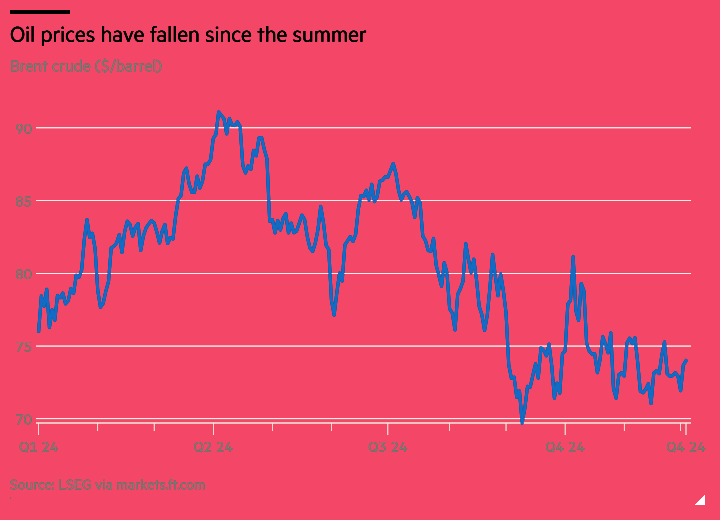
In June, Opec announced its intention to continue limiting oil supply but also indicated plans to gradually reduce voluntary cuts by 2.2 million barrels per day starting from September. However, recent trends have led the group to delay the increase in oil output to avoid flooding a declining market. The price of Brent crude oil, a global benchmark, has dropped by over 9 percent since the last meeting in June. As of Wednesday, it was priced at $72.58 per barrel, down 1.4 percent.
Analysts believe that Opec wants to understand the incoming U.S. administration’s impact on global oil supply before making any decisions. Helima Croft, head of global commodity strategy at RBC Capital Markets, stated that the group is likely to take a cautious approach, suggesting they should wait for another quarter to assess the situation.
Under the outgoing President Biden’s administration, Iranian oil exports, primarily flowing to China, have been allowed to grow. Conversely, Trump has threatened to impose tariffs on certain oil producers and revive stringent measures targeting Iran’s oil exports.
Amrita Sen from Energy Aspects noted that the potential policies from Trump present considerable uncertainty. She pointed out that while it’s unclear how tariffs will affect oil prices, they are generally unfavored, and the intensity of Trump’s approach toward Iran is also unclear.
Jorge Leon, a former Opec staff member, anticipates that Opec will aim to play it safe by extending the production cuts for another two to three months. Recently, the U.S. announced it would start sanctioning specific tankers exporting Iranian oil, which contributed to a 3 percent spike in oil prices.
Some analysts suggest that Saudi Arabia is cautious about appearing too eager to increase production, especially if sanctions against Iranian oil proceed effectively. They are expected to wait until it is evident that the market requires more oil.
Delaying the decision also allows Opec+ to monitor whether oil demand from China increases, as the government seeks to stimulate its economy. This delay could extend until the winter maintenance season, a period typically marked by lower oil demand.
While the market seems to have already accounted for a delay in unwinding production cuts, there are murmurs that some Opec+ members, particularly Iraq, Kazakhstan, and the UAE, are pushing to raise their production quotas after having invested in boosting their capacity.
Concerns about internal disagreements within Opec were heightened when the organization recently postponed a meeting scheduled for four days, attributing it to a clash with the Gulf Cooperation Council meeting.
Both Raad Alkadiri from Eurasia Group and Croft emphasized that adherence to production quotas will remain a crucial issue closely watched by investors. Reports suggest the UAE is currently producing 1 million barrels per day over its quota, with Iraq exceeding its limits by 350,000 barrels, and Kazakhstan producing an additional 50,000 to 100,000 barrels beyond its quota.
Alkadiri stressed that the question over the coming months may revolve around Opec’s discipline, rather than just its formal production statements. A decline in compliance with quotas could mimic the effects of unwinding production cuts, but in a less overt manner.