

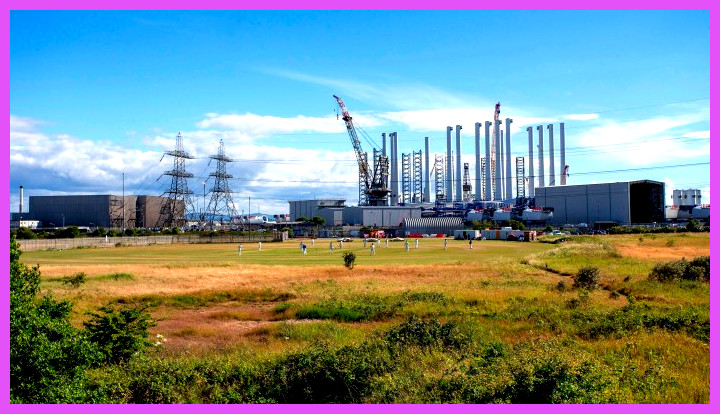
French energy company EDF, which is partly owned by the state, has decided to extend the operation of four older nuclear power stations in the UK. This move is expected to strengthen the UK’s energy security.
The plants, Hartlepool and Heysham 1, which were set to close in March 2026, will now stay open until March 2027. Meanwhile, Heysham 2 and Torness, initially slated for closure in March 2028, will now operate until March 2030.
These power stations, located in northern England and southern Scotland, were built in the 1980s. They were originally supposed to close in 2023, but this is not the first time their lifespan has been extended.
This extension will help fill the gap caused by delays at the Hinkley Point C power station that’s under construction in Somerset. This facility is now expected to begin operations no sooner than 2029, which is four years behind its original timeline.
The UK government is focused on finding solutions to meet the increasing demand for low-carbon energy, part of a larger effort to decrease carbon emissions. Under Prime Minister Sir Keir Starmer’s leadership, the goal is to have a completely decarbonized electricity grid by 2030.
A recent report from the National Energy System Operator suggested that at least one of the four nuclear plants would still be operational by 2030. While all four will eventually be closed by that date, EDF aims to keep them running longer depending on safety assessments and regulatory checks.
The company announced the new timelines after a meeting in Paris and stated that these dates represent the most likely scenarios for how long the stations could continue to operate, although there is a possibility of earlier closures.
Mark Hartley, managing director of EDF’s nuclear operations, mentioned that the company has put around £8 billion into its UK nuclear projects since 2009 and plans to invest an additional £1.3 billion from 2025 to 2027.
Currently, these four aging gas-cooled reactors are among the last five nuclear plants remaining in the UK after several others were shut down due to age. Sizewell B in Suffolk, a newer pressurized water reactor, began operation in 1995 and is due to close in 2035, though it could potentially be extended for another two decades.
Nuclear power generated about 14% of the UK’s electricity last year, which is a decline from around 20% in 2013, according to government data.
Despite the challenges in boosting nuclear capacity, Hinkley Point C is the only new nuclear facility being constructed in Britain. EDF and the UK government are also exploring investment for a second proposed plant, Sizewell C.
In response to EDF’s announcement, Fintan Slye, the chief executive of the National Energy System Operator, affirmed the ongoing importance of nuclear power in the UK’s electricity mix. Ed Miliband, the energy secretary, highlighted the extensions as a positive development for the nation’s energy independence.