

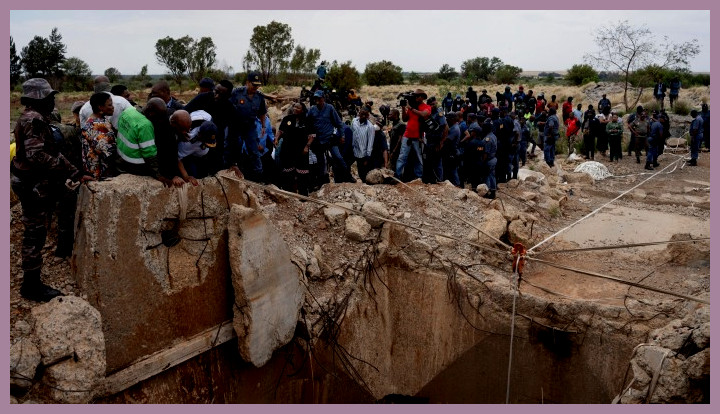
Local communities in South Africa are stepping in to deliver emergency supplies to illegal gold miners trapped underground due to a police blockade. This standoff has highlighted the growing issue of illegal mining in the country, driven by widespread economic hardship.
The miners, whose numbers are estimated to range from a few hundred to several thousand, have been stuck at the abandoned Buffelsfontein Mine in Stilfontein, located east of Johannesburg. They have been underground for weeks following a police operation that started in late October aimed at arresting them.
Concerns are growing as advocates warn that the miners are running low on necessary supplies. Last Saturday, the high court in Pretoria issued an interim order directing the police to lift the blockade in preparation for a hearing on Tuesday, allowing for urgent aid to be delivered.
Since the police began their operation, more than 1,000 illegal miners, commonly referred to as zama zamas, have voluntarily surfaced and been arrested, including the recovery of a deceased miner’s body. Negotiators have indicated that those still underground may be too weakened to come out.
The heavy-handed police tactics have sparked a debate in South Africa. Supporters argue that strict actions are necessary to combat rampant crime, while critics see zama zama mining as a consequence of a faltering economy, where one in three people struggle to find employment.
Khumbudzo Ntshavheni, a minister in President Cyril Ramaphosa’s government, made it clear that the authorities would not provide assistance to what they consider criminals. “We are going to smoke them out. They will come out,” she stated.
However, Yasmin Omar, a lawyer for a nonprofit organization appealing to the Pretoria High Court for aid, described the government’s stance as inhumane. Omar emphasized that the community deserves to ask crucial questions like why these abandoned mines still exist and why so many impoverished people feel compelled to risk their lives underground.
With the court’s order permitting aid, the community can now provide food and essentials to those trapped. Many in the vicinity of the mines blame the government for failing to offer better opportunities, gathering around the sites waving banners that read “Free our brothers” and “Smoke out the ANC,” alluding to the ruling political party.
A community member, Nozipho Ntuli, shared her family’s struggles, stating that her husband has been underground for months due to desperation caused by poverty. “We are starving and there’s no one to turn to for help,” she said, highlighting the dire choices facing many in her community.
Local police have indicated that the court order will not stop their efforts and warned that those who resurface healthy will be arrested, while those who are unwell will receive medical attention under police supervision.
Neal Froneman, the CEO of mining company Sibanye-Stillwater, argued that the government’s response to this crisis has been slow, insisting that the focus should be on dismantling the organized crime underlying illegal mining activities rather than just targeting the individuals involved. He pointed out the need for a more effective approach to combat this escalating issue in local mining areas.