

Key Update:
- Sunrun, Tesla, and Renew Home plan to add nearly 17 GW of distributed energy capacity to enhance the U.S. power grid, according to company statements released Wednesday.
- This collaboration, labeled a “capacity-as-a-solution” initiative, leverages the vast resources of the country’s biggest home energy providers. According to Chris Rauscher from Sunrun, their solar and battery customers are mainly located in key areas like Texas, California, and Virginia. Renew Home manages over 8 million smart thermostats and other connected devices.
- The alliance aims to tackle the challenge of connecting data centers to the grid swiftly while offering benefits to middle-class families through payments for participating in grid services, Rauscher explained.
Insights:
The combined efforts of these companies could yield 16.8 GW of capacity from around 12 million devices installed in 9 million homes across the U.S. They currently manage 7.8 GW of battery capacity and approximately 9 GW from HVAC systems that utilize smart thermostat technology.
Specifically in Texas, the companies hold 1.3 GW of HVAC and 440 MW of battery capacity. California, which ranks third in terms of data center presence, sees nearly 1.1 GW in HVAC and 3.6 GW in batteries.
Experts have long discussed the potential of distributed resources for grid efficiency. “The scale of available resources is often underestimated,” noted Ben Brown, CEO of Renew Home.
In Virginia, known for its significant data centers, the partnership has around 37 MW of battery capacity and 276 MW of HVAC capacity and anticipates reaching 500 MW by 2030.
Renew Home and its collaborators expect a strong demand for distributed resources in the coming years. “We are just at the beginning of what we will see in battery and electric vehicle adoption,” Brown said.
With around 80 million U.S. homes having controllable HVAC systems, while only 20 million are equipped with smart thermostats, there lies a significant opportunity for improved capacity, according to Brown.
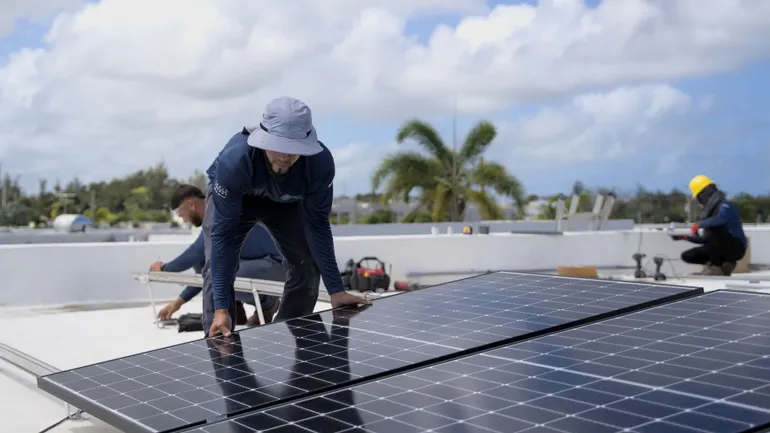
Rauscher pointed out that the U.S. is facing urgent needs for readily available distributed capacity due to rising electricity demand and an aging grid, particularly highlighted in Puerto Rico, where rooftop solar systems are becoming increasingly vital.
Hurricane Maria greatly impacted Puerto Rico’s transmission grid in 2017, amplifying existing reliability issues. Demand for power continues to rise, especially as the island’s older fossil-fuel generators struggle to stay online.
Recently, Puerto Rico experienced 225 load-shedding events, illustrating the ongoing challenges it faces.
Rauscher noted that Puerto Rico’s circumstances highlight broader dynamics affecting both the island and the mainland as the energy situation evolves.
LUMA Energy has called for support from Sunrun’s initiative multiple times due to increased electricity demands this year, in part due to high temperatures.
Janisse Quiñones from LUMA acknowledged the significant role of over 200,000 customers with solar and batteries in alleviating power outages earlier this month.