

Recent Developments in Power Transmission
- The Southwest Power Pool (SPP) board has approved a hefty $8.6 billion plan for 50 new transmission projects across its 14-state area. This is aimed at addressing increased peak demand, which is anticipated to double to 109 GW within the next decade.
- A pivotal element of this plan involves creating a 765-kV transmission backbone, which has the capacity to carry four times more power than current 345-kV lines, all while operating more efficiently. The current transmission system is at its limit, and simply adding new power sources won’t suffice.
- These 765-kV lines represent the highest voltage tiers in the U.S. and have only recently been approved in Texas, marking a significant milestone in regional energy infrastructure.
Understanding the Goals Behind These Developments
As electricity demands soar, both SPP and the Electric Reliability Council of Texas (ERCOT) are focusing on 765-kV projects to reduce energy loss and ensure smooth delivery of electricity to areas with high demand.
According to SPP, with new load increments, there’s potential for energy consumption in the region to rise by as much as 136%. Investing in updated transmission systems is crucial for keeping costs manageable, ensuring reliability, and supporting economic growth.
Even at modest estimates, SPP predicts a 35% spike in demand, underscoring the need for prompt investment in transmission infrastructure. This February, SPP selected Xcel Energy to build the first 765-kV lines outlined in its 2024 strategy, while AEP Texas prepares to construct a similar line in Texas.
The approved plan features a total of 949 miles of 765-kV lines and an addition of 62 miles of new 345-kV lines, chosen from a more extensive portfolio valued at $18 billion.
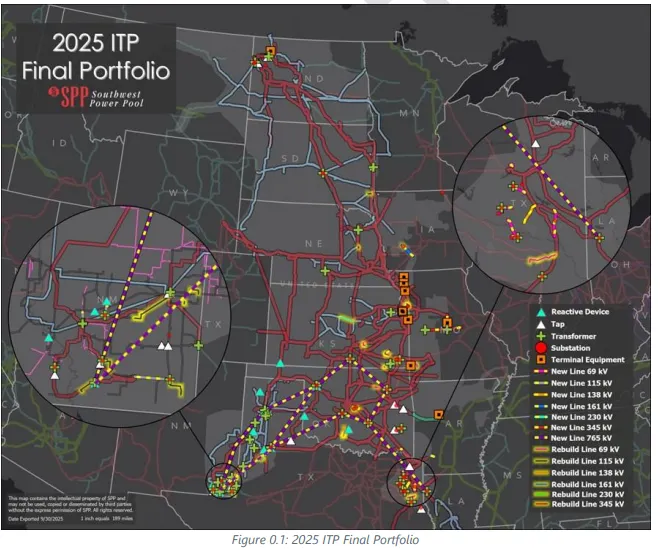
Source: Southwest Power Pool
SPP’s vice president of engineering, Casey Cathey, noted that this plan will provide the necessary infrastructure to both facilitate new energy generation and meet growing demand, all while preserving reliability. The investments also focus on incorporating critical resources like natural gas units into the energy mix.
Without integrating 765-kV technology, meeting future demand could necessitate substantial additional infrastructure, using up to six times the resources and land than would otherwise be needed, SPP states.
Moreover, utilizing high-voltage transmission can lead to significant savings for consumers. It offers a financially efficient way to manage rising electricity costs, providing power at rates up to 75% less expensive per megawatt compared to traditional lower-voltage methods.