

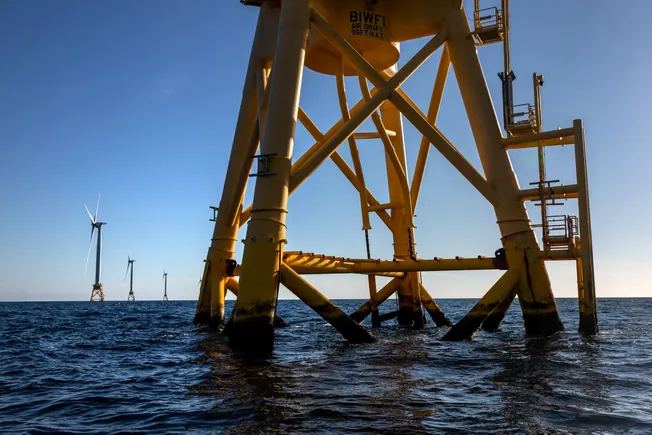

Revolution Wind, a significant offshore wind farm aiming to deliver 700 MW of power to Rhode Island and Connecticut, has paused construction following a directive from the Department of the Interior’s Bureau of Ocean Energy Management. The developer, Ørsted, announced this halt on Friday.
The project, developed in a joint venture with Global Infrastructure Partners’ Skyborn Renewables, has successfully secured full permits and is now 80% complete. Notable milestones include the installation of all offshore foundations and 45 of the planned 65 wind turbines.
Ørsted is currently exploring various options to quickly address the situation. This means they are looking to engage with relevant agencies for clarification and potentially considering legal actions, with the goal of resuming construction by the latter half of 2026.
According to investment bank Jefferies, there appears to have been minimal communication between Rhode Island and Connecticut regarding Revolution Wind prior to the work stoppage. Investors are now keenly interested in what arrangements could be made to reactivate construction, similar to the Empire Wind project, yet a clear solution is not immediately apparent.
Earlier this year, a comparable halt order was issued for the 810 MW Empire Wind 1 project off the coast of New York, which was later lifted after negotiations with Governor Kathy Hochul. Following that, Interior Secretary Doug Burgum expressed optimism about moving forward with crucial natural gas pipeline capacity.
Reports indicate that the order issued by BOEM’s Acting Director Matthew Giacona aims to safeguard U.S. national security and prevent conflicts with other legitimate uses of maritime zones.
In light of the halt, Ørsted confirmed compliance with the order, prioritizing the safety of workers and the environment, while assessing the potential financial impacts of this development. Following the announcement, the company’s shares dropped to an all-time low of $9.31.
Ørsted also revealed plans for a $9.4 billion rights issue to strengthen its financial standing, indicating an effort to maintain its offshore wind projects in the U.S. despite the uncertain regulatory environment.
The recent developments underscore the growing regulatory challenges facing offshore wind projects in the United States, highlighting the need for robust planning and communication among stakeholders.