

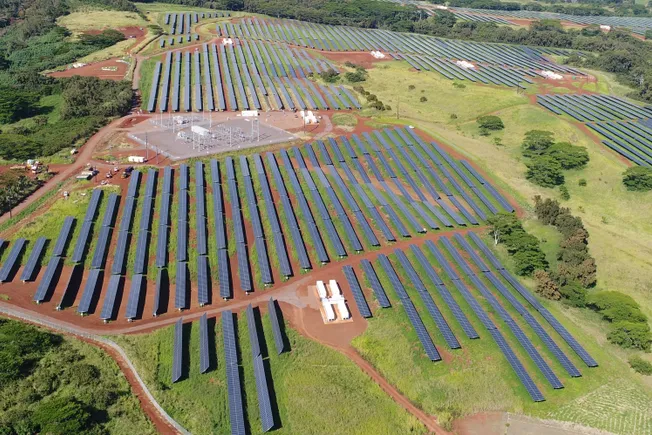
Kauaʻi Island Utility Cooperative (KIUC) is taking significant steps towards renewable energy by planning to purchase power from two new solar-plus-battery-storage projects by AES Hawaiʻi. This move aims to increase the utility’s renewable energy supply to nearly 80% by the year 2028.
KIUC has submitted a request to the Hawaiʻi Public Utilities Commission (PUC) for approval of power purchase agreements (PPAs) that will last 25 years and feature fixed prices. The projects in question are the 35-MW Mānā project and the 43-MW Kaahanui project, both of which include a storage capacity of four hours. According to the utility, the Mānā project will price power at $127 per megawatt-hour (MWh), while the Kaahanui project will cost $133.40/MWh.
Additionally, there is potential for reduced costs under the Mānā contract, which could see a decrease of up to $13.50/MWh if it qualifies for a loan from the U.S. Department of Agriculture’s Powering Affordable Clean Energy Program. Meanwhile, the Kaahanui project could also benefit, potentially lowering its price by $10/MWh if it meets specific conditions related to federal tax credits for renewable energy projects.
If these projects are developed, they are expected to replace oil-based generation, which would provide significant savings for KIUC customers—about $13.4 million in the first year and around $800 million throughout the lifespan of the agreements.
David Bissell, the president and CEO of KIUC, highlighted the positive trend in energy costs, stating that the cooperative has achieved substantial rate stabilization over the past five years due to its increasing use of renewable energy and fixed-price agreements. He mentioned that KIUC’s rates have transformed from the highest in the state to among the lowest within two decades. He also noted that these new projects would help shield customers from fluctuations in oil prices.
Looking forward, KIUC plans to utilize the energy stored from these projects to meet peak demands in the afternoons and evenings, replacing oil-fired generation during those high-demand periods and enhancing grid stability. It is estimated that the energy produced from these two projects will account for 35% to 40% of KIUC’s annual energy output.
Currently, KIUC caters to around 40,000 customer accounts and has requested the PUC to approve the proposed PPAs by October 31.
On a separate note, KIUC has chosen to abandon its plans for a West Kauai pumped-storage hydropower facility, which was intended to be paired with solar power and battery storage by AES. The Mānā project will be situated near the site planned for the solar components of the former project.
AES operates approximately 8.6 gigawatts (GW) of utility-scale and community solar, wind, and energy storage projects across 28 U.S. states, and is further developing around 51 GW, as reported by KIUC to the PUC.