

Hello and welcome back to our Energy Source update from New York.
Recently, President Donald Trump made headlines by canceling Chevron’s special license to work in Venezuela. This move aims to pressure Nicolás Maduro, the country’s authoritarian leader, into scheduling fair presidential elections. Analysts believe this could seriously impact Venezuela’s oil industry, as Chevron is an essential supplier of diluent, a crucial substance that helps process the heavy crude oil produced in the country.
Schreiner Parker, an analyst from Rystad Energy, noted that losing Chevron’s diluent support could be a significant setback for Venezuela’s production.
In related news, BP has decided to remove its production cut targets and focus more on renewable energy. The company has also announced an increase in its oil and gas spending by 20%, raising it to $10 billion per year. This shift appears to be influenced by activist investor Elliott Management, which now possesses nearly a 5% stake in BP.
Today, let’s take a deeper look at the U.S. liquefied natural gas (LNG) industry. President Trump has been using LNG exports as a negotiating tool, pressing the EU to commit to buying large quantities of American oil and gas or potentially face tariffs. Recently, he even threatened to impose a 25% tariff on EU imports.
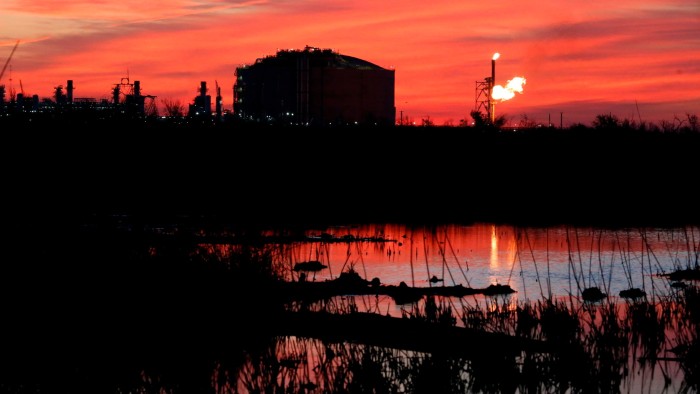
Despite Trump’s support, the expansion of the American LNG industry encounters several obstacles that could delay project timelines. The U.S. Department of Energy has recently approved the Commonwealth LNG project, which is the first major export initiative to be greenlit since former President Biden halted LNG export licenses to countries without free trade agreements last year. The terminal will be located in Cameron Parish, Louisiana, and will proceed once it secures enough contracts to finance the estimated $4.8 billion needed for its construction.
Ben Dell, managing partner of Kimmeridge, expressed satisfaction over the administration’s quick action, stating, “We have been sitting in the queue for over two years,” and they aim to finalize investment decisions soon.
However, Dell also warned that not all announced projects might see completion. Market conditions and timing will heavily influence their chances, with estimates suggesting that only 50-70% of announced projects could proceed.
Experts have highlighted several risks that could hinder the growth of the U.S. LNG industry, including the potential for a supply glut that may drive prices down, legal disputes, and insufficient infrastructure to cater to the rising demand. The U.S. is currently the world’s leading LNG producer but is facing growing competition from places like Qatar, where state-supported firms can quickly ramp up supply.
Mathieu Utting, another analyst from Rystad Energy, noted that an oversupply in the market could be detrimental if all proposed projects are approved. Prices would likely drop, making it harder for producers to maintain profitable returns necessary for financing new projects.
Looking ahead, the market could face oversupply issues by the mid-2030s, with JPMorgan forecasting that U.S. production will comprise over a third of global supply by 2030. Although the U.S. has adequate supply, it struggles with delivery challenges, including pipeline infrastructure and storage capacity, to meet growing demands.
Charlie Riedl, president of the Center for LNG, remarked that while the U.S. has a robust gas pipeline system, additional infrastructure is needed to meet future demand.
Despite regulatory challenges and hurdles in securing long-term contracts, global demand for LNG remains strong. Shell estimates that LNG demand could rise by 60% by 2040, mainly due to economic growth in Asia.
As the U.S. continues to navigate these challenges, it’s essential for industry players to remain adaptable and prepared for potential uncertainties in the market.