

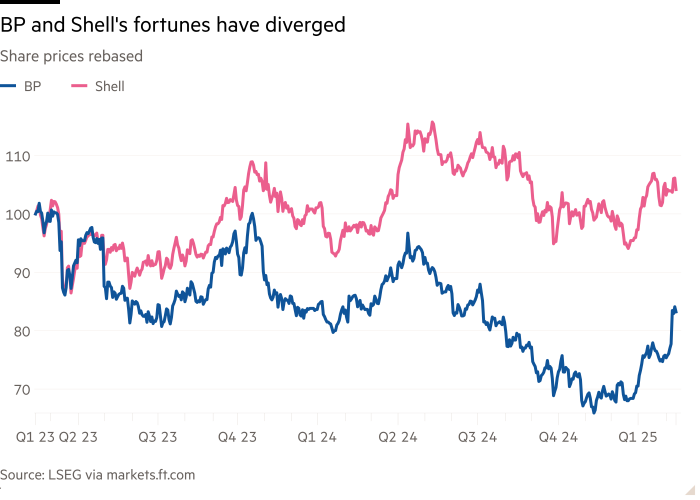
In recent discussions surrounding BP’s business strategy, the focus has been on how to effectively detach from unsuccessful initiatives. There are two primary approaches: gradually trimming down operations or decisively making cuts. It seems BP’s slower approach has not garnered much support from investors. Recently, the American activist investor Elliott Management has acquired nearly a 5% stake in BP, pushing the company to consider more drastic measures.
BP has identified several areas to potentially increase its value. While its upstream operating costs are competitive within the industry, the corporate expenses are not. The company plans to cut $2 billion by the end of 2026. Analysts from Goldman Sachs suggest that BP could reduce its operational costs by up to $7 billion, amounting to over 15% of its expected earnings before interest, taxes, depreciation, and amortization (EBITDA) for 2024, to align its spending with industry standards.
Although a complete breakup of BP is not anticipated, the company benefits from managing large industrial assets. Having both upstream production and downstream refining operations can be advantageous for trading.
BP’s chief executive, Murray Auchincloss, can consider streamlining certain operations without significant downsides. Analysts suggest that BP’s investments in low-carbon assets have not yielded high returns. Over the past four years, the company has invested $14 billion in various “transition growth engines,” which include renewable energy sources, hydrogen, and electric vehicle charging alongside its convenience store operations. BP has begun to reduce its investments in offshore wind by entering a joint venture with Jera, Japan’s largest power generation company, indicating there may be more opportunities for divestment.
According to Goldman Sachs, BP could raise about $26 billion by selling some of its low-carbon and pipeline businesses, along with a valuable lubricants division, Castrol, which might be valued at an additional $10 billion. Collectively, that could represent more than a third of BP’s current market value.
However, there’s little benefit in refocusing efforts if the core business isn’t performing well. While BP’s upstream portfolio is generally quality, its growth prospects look limited. Projections indicate that BP’s oil and gas production may decline in 2025 due to planned asset sales.
European investors are familiar with the challenges faced by established oil companies. For these companies, the narrative often revolves around dividends and share buybacks. At nearly any valuation, divesting assets could bring more value compared to BP’s current low enterprise value to EBITDA ratio of 3.8 times, as stated by S&P Capital IQ. By reducing its debt and refocusing its business, BP could reposition itself more competitively within the market.