

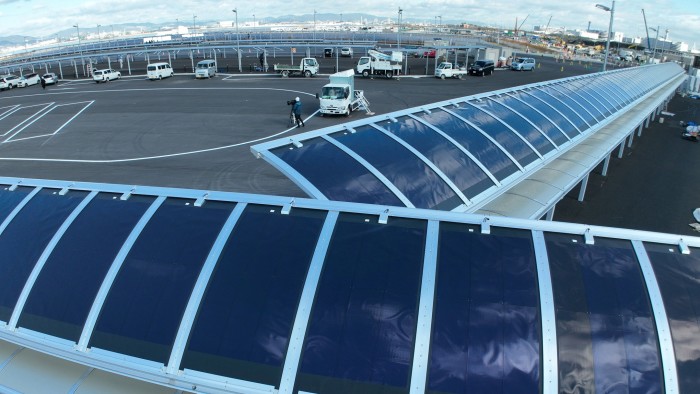
Japan is making a bold move by investing $1.5 billion in advanced solar technology, particularly in next-generation ultra-thin and flexible solar panels. This initiative aims to promote the use of a new type of solar cells known as perovskite cells, which could challenge China’s leading position in the renewable energy sector and help Japan decrease its reliance on fossil fuels.
Perovskite cells are much thinner than traditional solar panels, making them suitable for installation on various structures like stadiums and airports. This approach is especially beneficial for Japan, which has a mountainous landscape that limits space for large solar farms. The Japanese government has set an ambitious target: to generate energy equivalent to 20 nuclear power plants by 2040, planning for renewable sources to meet up to 50% of the country’s electricity needs.
To support this goal, the government has allocated approximately ¥157 billion ($1 billion) to Sekisui Chemical, a leading company in developing perovskite solar technology. This funding adds to an earlier investment of ¥60 billion focused on the technology’s initial development, with potential additional funds for creating green supply chains.
Sadanori Ito, a key government official, emphasized the importance of perovskite solar cells in achieving environmental goals, stating they are crucial for advancing renewable energy in Japan. Currently, China dominates solar panel production, controlling a whopping 85% of the global solar cell market. Japan’s focus on perovskite, which primarily uses iodine sourced from Chile and Japan, aims to diversify supply chains and reduce vulnerabilities associated with relying on a single country.
Though these new solar cells are expected to be expensive initially—potentially costing three times more than existing technologies—early adopters are likely to emerge in urban centers like Tokyo and Singapore. Experts believe Japan’s strategy is both practical and necessary to regain competitiveness.
Sekisui Chemical is actively working on commercializing this innovative technology. The company is aiming to produce 1 gigawatt of perovskite solar cells by 2030, supported by government funds. To tackle critical technical challenges, they have developed a special resin to prevent moisture damage, which has been a major hurdle in production.
With a new company established that employs 1,000 workers, Sekisui is gearing up for mass production, striving to increase the production width of the cells. The aim is to begin producing 100 megawatts annually by 2027 and to eventually bridge the cost gap with traditional silicon solar panels.
Sekisui’s commitment to enhancing the technology is also focused on finding effective methods for attaching the panels to various surfaces in urban environments. Company president Futoshi Kamiwaki views this as an essential step for entering the market and even expanding exports to the US and Europe, marking a crucial timeline in the global energy landscape.