

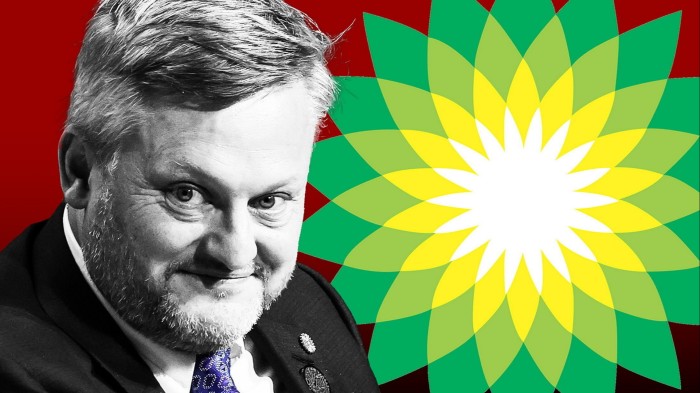
BP has informed its 39,000 employees that their annual cash bonus will be set at just 45% of the target due to a year marked by disappointing financial and operational results. The bonus system, which applies to top management as well, can reach up to 225% of the chief executive’s annual salary of £1.45 million.
Murray Auchincloss, who has been leading BP since January, is expected to receive a bonus that amounts to around half of his salary for the year 2024, according to someone knowledgeable about the company’s plans.
Recently, BP announced it achieved an underlying profit of $8.9 billion for the full year, down from $13.8 billion in 2023. This represents the company’s worst annual performance since it recorded a $5.7 billion loss in 2020 during the onset of the COVID-19 pandemic.
The company’s bonus program is evaluated based on multiple criteria: 50% on financial performance, 30% on safety and sustainability, and 20% on operational effectiveness. After reporting underlying profits of $1.17 billion for the last three months of 2024, which is about half of the previous quarter’s performance, BP communicated the bonus calculations to eligible staff.
Following these results, BP has committed to “fundamentally reset” its strategy and improve overall performance, especially under increasing scrutiny from activist investor Elliott Management, which has secured a stake in the company. While the exact size of Elliott’s investment remains unclear, other BP investors believe that this involvement will inevitably lead to changes within the company. Auchincloss has not commented on whether he has been in touch with Elliott.
On the stock market, BP shares showed little change by late Tuesday afternoon, climbing as much as 8% on Monday after news of Elliott’s investment became public, before settling down 0.6%.
Auchincloss faces mounting pressure to outline a new strategy following several quarters of disappointing results, concerns about the company’s aggressive transition to renewable energy, and a share price that has fallen behind its competitors.
In a statement, Auchincloss emphasized the goal of increasing “cash flow and returns,” assuring that a new direction for BP will be revealed during an investor day on February 26. He mentioned ongoing efforts to reshape the company’s portfolio, focusing on major new projects while continuing its commitment to low-carbon investments and noteworthy cost reductions.
Despite the calls for a strategic shift from BP’s previous CEO Bernard Looney’s approach of gradually cutting down oil production in favor of green energy, Auchincloss has recalibrated the company’s course, leading to a reduction in renewable projects and creating a separate joint venture for its offshore wind capabilities.
The main challenge for BP over the past year has been its refining sector, where profit margins fell significantly. The company’s refining and trading divisions slid from a pre-tax profit of $3.8 billion in 2023 to a pre-tax loss of $67 million the past year, prompting BP to put its Gelsenkirchen refinery in Germany up for sale.
“In refining, it has been a challenging year for all,” Auchincloss noted. “The team is addressing the issue, and we anticipate a substantial recovery in profitability.”
While some analysts believe that BP may have to scale back shareholder returns to fuel growth and reduce debt, the company maintained its dividend in the fourth quarter and announced an additional $1.75 billion in share buybacks.
In a notable move, during its recent results presentation, BP adopted former President Donald Trump’s reference to the Gulf of Mexico, redesignating it as the “Gulf of America.” Chevron, another major oil company, has similarly adopted this terminology in recent statements. Auchincloss affirmed, “The United States has changed it to the Gulf of America, and so have we, along with all of our competitors.”