

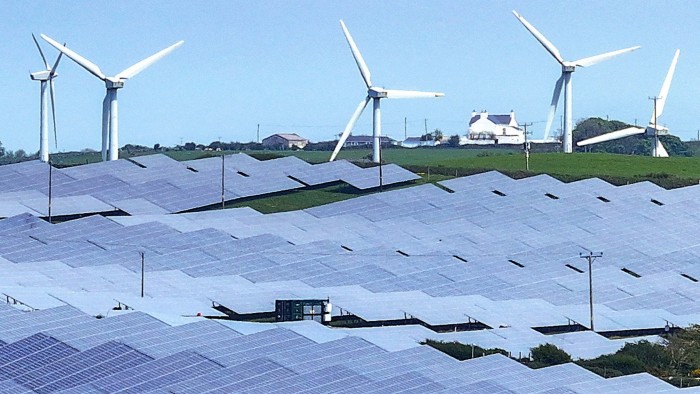
Britain is facing significant challenges in meeting its renewable energy goals, according to a recent analysis. Despite government efforts to remove obstacles for the renewable sector, the UK is expected to fall short of its clean energy targets by a massive 32 gigawatts, which is enough to power millions of homes.
A report from consultancy firm Cornwall Insight suggests that practical issues and uncertainties regarding market reforms are impeding progress in solar and wind power development. This news is disheartening for Sir Keir Starmer’s government, which has been focused on decarbonizing the UK’s electricity grid by 2030.
Tom Musker, a modelling manager at Cornwall Insight, emphasized the crucial need to tackle operational and investment challenges that are hindering the growth of renewable energy. He highlighted that making timely investments in infrastructure and providing clear guidelines on market reforms are essential to unlocking the UK’s clean energy capabilities.
The government previously announced ambitious targets for renewable energy by 2030, aiming for 43-50GW of offshore wind, 27-29GW of onshore wind, and 45-47GW of solar power. Currently, the UK has a capacity of 14.7GW of offshore wind, 15.7GW of onshore wind, and 17.6GW of solar power. Cornwall Insight predicts that by 2030, the capacities will only reach 37GW for offshore wind, 17GW for onshore wind, and 29GW for solar power, resulting in a significant shortfall.
In response to these challenges, the government has implemented measures to improve conditions for the renewable energy sector. This includes lifting restrictions on onshore wind developments in England, granting planning permissions to new solar farms, and increasing subsidies for renewable energy projects. Additionally, the National Energy System Operator is working to reduce the time needed to connect to the UK’s overburdened electricity grid.
Recently, the government announced plans to limit the number of judicial reviews that opponents of infrastructure projects can initiate, addressing concerns that such objections may slow down project timelines. However, Kate Mulvany, a principal consultant at Cornwall Insight, noted that despite these measures, the UK is still not on track to meet its goals. She pointed out that while the messaging from the government has been strong, action on comprehensive planning reforms still has a long way to go.
Investors remain cautious, awaiting the government’s decisions on significant changes to the electricity market, including potentially dividing it into different pricing zones. Cornwall Insight’s forecasts take various factors into account, including market sentiment and new project announcements.
Last year’s predictions were lower than the current ones, indicating some progress due to government policies. However, Cornwall reiterated that these forecasts are not fully comparable due to changes in their modeling approach.
The Department for Energy Security and Net Zero responded by stating it does not concur with Cornwall’s forecasts, asserting that achieving clean power by 2030 is feasible. The department emphasized efforts to improve the grid system and accelerate planning decisions to support significant renewable projects.