

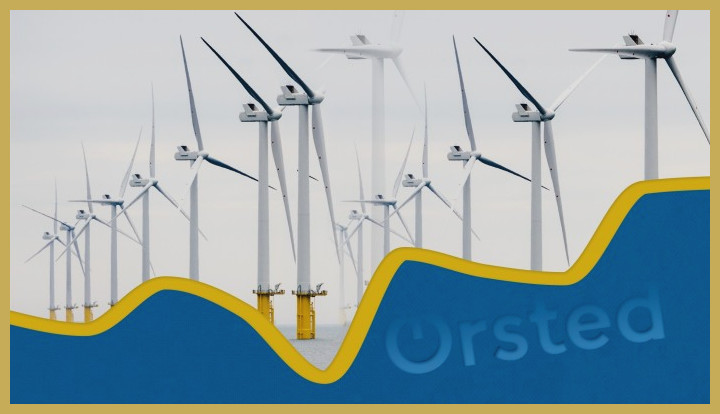
As Danish renewable energy giant Ørsted works to rebuild its reputation after a tough year, its competitor Equinor from Norway has been quietly increasing its stake in Ørsted. In October, Equinor announced it has taken a 10% stake in the company, expressing its intention to be a supportive shareholder.
This move shows that despite challenging times, there is still faith in Ørsted, whose stock has plummeted by about 70% since 2021 due to management troubles and economic challenges. Furthermore, Equinor sees this investment as a cost-effective way to further its own decarbonisation efforts, especially as it moves away from fossil fuels.
It’s notable that Equinor, which still invested heavily in fossil fuels—20% of its budget was allocated to renewables and carbon capture last year—is now backing Ørsted, the world’s leading offshore wind company. Ørsted’s transformation from a fossil fuel-centric company to a leader in renewables reflects a broader shift in the energy sector seeking to meet climate goals.
Ørsted has faced difficulties balancing its rapid growth and ambitious climate goals with the pressures of rising costs and changing market conditions. This has led to the halting of numerous significant projects in offshore wind and hydrogen development.
Across Europe, many energy companies are feeling the crunch as the era of easy borrowing comes to an end. However, the renewable energy sector is still growing, with 565 gigawatts of new renewable capacity added last year—largely thanks to an explosion in solar energy in China. Offshore wind, crucial for Ørsted, has become increasingly competitive, with costs dropping significantly over the past few years.
Current geopolitical events also impact the renewable sector. Following Donald Trump’s re-election, concerns have arisen about the fate of green energy initiatives, as his administration may dismantle key environmental regulations and financial incentives.
Ørsted’s journey began back in 2009 when, known as Dong Energy, it pledged to generate 85% of its power from renewables by 2040. The company has grown substantially since then, capitalizing on the North Sea’s high wind speeds and supportive government policies. Projects like Hornsea 1 in the UK have advanced offshore wind technology and capacity.
Despite changing market dynamics, Ørsted has made significant strides, gradually reducing its carbon emissions and increasing its reliance on renewable sources. The company reported reaching a remarkable 75% green energy output as of 2018.
However, in the wake of rising interest rates and market pressures, Ørsted found itself needing to scale back its ambitions. The company recently pulled out of several offshore wind projects, leading to considerable financial losses and workforce reductions.
Analysts are cautious, with some noting the fragile state of the clean energy sector amid economic uncertainty. Companies are now re-evaluating their renewable projects, with some, including Ørsted, shifting focus to more financially viable strategies.
Despite the challenges, Ørsted remains focused on achieving its revised target of 35 to 38 gigawatts of renewable capacity by 2030, with significant investments earmarked for battery storage and sales of wind farm stakes to raise capital.
Looking ahead, Ørsted’s chief executive, Mads Nipper, believes that the disappointing factors of recent years will stabilize. He insists that while challenges exist, they are still capable of driving successful renewable energy operations.