

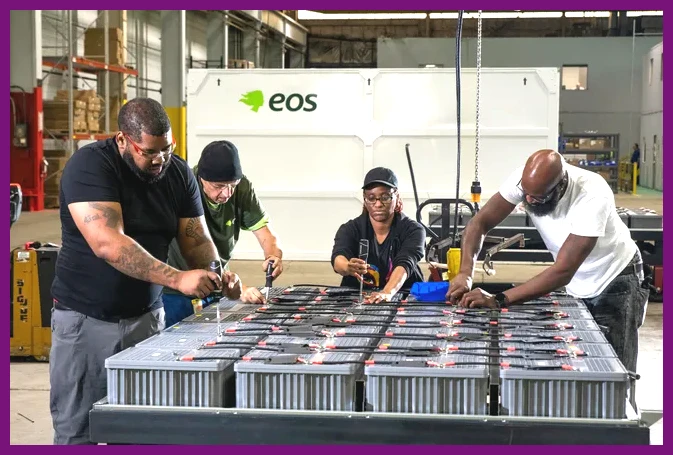
Eos Energy Enterprises has successfully secured a loan of $303.5 million, backed by the U.S. Department of Energy’s Loan Programs Office. This funding will boost the manufacturer’s efforts in producing its innovative zinc-based energy storage systems.
With this loan, Eos intends to increase the production capacity at its battery manufacturing facility located in Turtle Creek, Pennsylvania. The goal is to ramp up production to 8 GWh annually by 2027. To achieve this, Eos plans to establish four automated manufacturing lines. Presently, one line is already operational.
According to the Department of Energy, the loan guarantee currently encompasses two of these manufacturing lines. Should Eos receive further approvals and finish the required environmental assessments, it could secure coverage for the remaining two lines as well.
As of September 30, the company reported a backlog of orders worth $589 million, equivalent to approximately 2.3 GWh, along with a commercial pipeline valued at $14.2 billion, which totals around 59 GWh. Recently, a municipal utility in Springfield, Missouri, made an agreement to purchase Eos batteries amounting to 36 MW with a discharge duration of six hours.
In August 2023, Eos was initially awarded a conditional loan guarantee of up to $398.6 million. The reduced final loan amount reflects the overall project costs being lower than expected and an investment of up to $315.5 million from Cerberus Capital Management.
Eos’s Chief Financial Officer, Nathan Kroeker, emphasized that the loan guarantee from the DOE, combined with Cerberus’s strategic investment, will provide essential capital needed to create a successful manufacturing operation.
The DOE’s loan facility allows Eos to make up to four draws on the guaranteed loan, based on the company’s achievement of various milestones linked to production and operational changes. The facility is set to mature on June 15, 2034, with loans subject to interest rates linked to U.S. Treasury rates plus a 0.375% spread.
Eos’ Z3 battery storage system is designed for safety, flexibility, scalability, and sustainability, and it utilizes predominantly U.S.-sourced raw materials. This system offers utilities and commercial customers an alternative to lithium-ion and lead-acid batteries, catering to discharge needs ranging from three to twelve hours.
The company also highlighted that the Inflation Reduction Act could enhance its competitiveness by allowing production tax credits for locally manufactured battery components and tax benefits for projects using domestic content.
However, Eos reported experiencing a net loss of $417.7 million in the first nine months of this year, along with negative cash flows from operations totaling $111.3 million.