

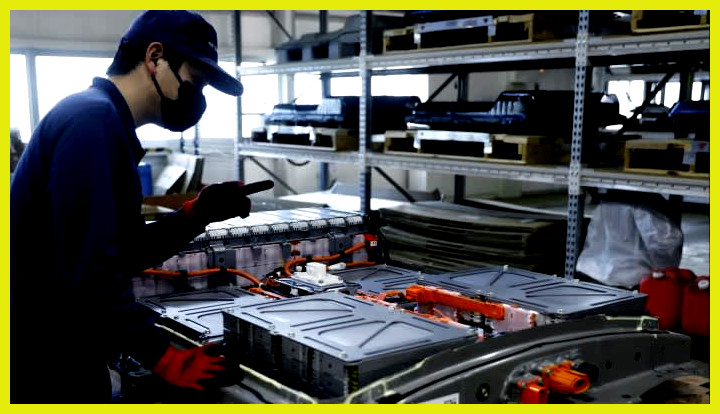
In a bold move poised to disrupt the energy landscape, US battery innovator Lyten is investing a staggering sum—exceeding $1 billion—to establish the planet’s inaugural large-scale facility dedicated to the production of lithium-sulfur batteries. This nascent technology heralds a potential shift in the United States’ reliance on China, a dominant force in the supply of critical metals essential for the energy transition.
Nestled in the bustling city of Reno, Nevada, the ambitious factory is set to commence production by the year 2027—a pivotal milestone in the quest to commercialize a battery type that stands ready to challenge the well-entrenched lithium-ion paradigm. Unlike its predecessor, this revolutionary battery does not depend on graphite, nickel, manganese, or cobalt—the vital metals that are predominantly monopolized by China.
Celina Mikolajczak, the astute chief technology officer at Lyten, articulated this vision, asserting that the company’s innovative battery chemistry could weaken China’s stranglehold on the market. With an eye toward the future, the company anticipates ramping up to an impressive 10 gigawatt-hours of production by around 2032 at their Reno facility, targeting industries ranging from drones and satellites to electric vehicles (EVs) that promise longer durations than currently available lithium-ion alternatives.
“The leverage that China wields over the electric vehicle sector, affecting all battery cell producers, stems primarily from their dominance in graphite supply,” Mikolajczak commented. She emphasized Lyten’s commitment to sourcing sulfur domestically and procuring lithium from American suppliers along with partners outside of China. “If we are going to innovate with a new cell chemistry, we must decisively detach ourselves from the existing supply chains,” she added.
Lyten’s ambitious undertaking surfaces amid an escalating competition among US battery start-ups, all striving to unveil the next breakthrough battery technology capable of rivaling Chinese supremacy. These innovators promise not just materials that are more accessible and cost-effective but also superior energy densities that could revolutionize vehicle range and charging speeds.
Although the Biden administration’s landmark Inflation Reduction Act has dangled lucrative manufacturing tax incentives for battery manufacturers, fierce competition from Chinese imports, a dip in electric vehicle demand, and challenging economic conditions have compelled numerous companies—including LG Energy Solution, Freyr, and GM’s Ultium Cells—to pause or delay their ambitious projects.
European manufacturers are encountering a parallel struggle. A subsidiary of Northvolt, the continent’s leading battery maker, recently filed for bankruptcy, representing a significant blow to Europe’s aspirations to contend with Asia’s battery behemoths.
Milo McBride, a fellow at the Carnegie Endowment for International Peace, succinctly dubbed the commercialization of lithium-sulfur batteries a “golden goose” for bolstering US battery competitiveness. “The West is lagging in scaling its critical mineral supply chains at the necessary pace,” McBride remarked. “This technology presents a compelling geopolitical opportunity for the US by offering a battery solution that diminishes the long-term reliance on certain minerals and associated chemicals.”
Lyten’s innovative approach substitutes the graphite commonly incorporated in lithium-ion battery anodes with lithium metal, while replacing the nickel, manganese, cobalt, and lithium typically featured in cathodes with sulfur—an unprecedented shift that could redefine industry standards.
With backing from industry titans such as Stellantis and FedEx, Lyten has amassed $425 million in financing and secured a $4 million grant from the Department of Energy earlier this year. The company estimates it may qualify for $1.5 billion in manufacturing tax credits and is negotiating with the state of Nevada for incentives that could cover a significant portion of its capital expenditures.
The Republican-led state has emerged as a magnet for electric vehicle and battery investments, attracting nearly $7 billion in supply chain commitments since the IRA’s inception, despite bipartisan opposition to the law and threats from former President Donald Trump to reverse funding should he reclaim office in November.
Yet, hurdles loom for lithium-sulfur batteries, particularly concerning their underlying chemistry. While they promise energy densities far surpassing those of traditional lithium-ion counterparts, they face the daunting challenge of rapid degradation, primarily due to a chemical phenomenon identified as the polysulfide shuttle.
“That’s the Gordian knot,” Mikolajczak mused, referring to the intricate task of utilizing carbon structures to regulate sulfur movement within the battery and enhance its lifespan. The company anticipates venturing into defense applications—targeting drones and satellites—within the coming year, with aspirations to extend their lifecycle for electric vehicles in the subsequent years.
Despite the enthusiasm surrounding lithium-sulfur technology, some developers remain wary of its potential to eclipse lithium-ion batteries in the fiercely competitive electric vehicle arena. Soaring interest rates and a downturn in EV demand have further tightened investors’ purse strings regarding funding for capital-intensive battery initiatives.
“Lithium-ion batteries have established a strong foothold in the EV sector, with Chinese manufacturers driving prices down to less than $50 per kilowatt-hour,” cautioned Lee Finniear, CEO of Li-S Energy, an Australian company navigating this intricate landscape.