

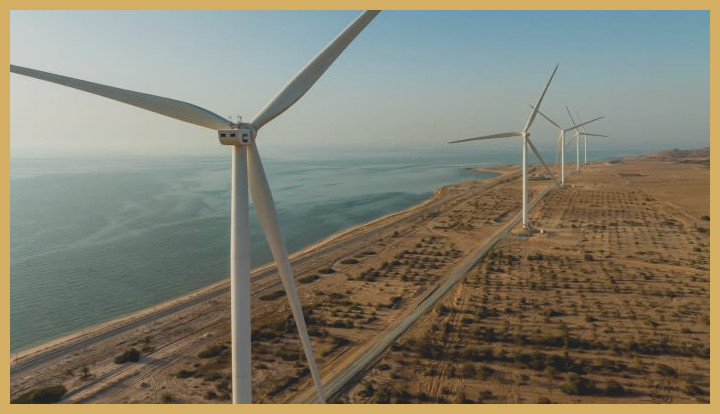
Masdar, the largest renewable energy powerhouse in the Middle East, has unfurled its ambitious blueprint: a staggering 100 gigawatts of wind and solar capacity by the decade’s end. To put that into perspective, this colossal figure mirrors the entirety of the UK’s power generation.
If realized, this goal could catapult the Abu Dhabi-based enterprise into the echelons of the world’s foremost renewable energy juggernauts, surpassing well-established rivals like Spain’s Iberdrola, France’s Engie, and Germany’s RWE.
Backed by a coalition of major players—Adnoc, the state oil titan; Taqa, the key entity in state water and power; and Mubadala, the sovereign investment fund—Masdar is poised to unleash an international investment blitz. So far this year, the company has initiated nearly €6.5 billion worth of endeavors across Spain and Greece, signaling aggressive expansion.
In the United States, Masdar has struck a significant chord by securing a deal with Terra-Gen, one of the country’s preeminent renewable energy firms. Meanwhile, across the pond in the UK, the company holds a 49% stake in the monumental £11 billion Dogger Bank South project, destined to be one of the most colossal offshore wind farms upon its completion.
According to Mohamed Jameel Al Rahami, the astute CEO of Masdar, the company’s commitment to substantial investments in the Middle East, Europe, and the U.S.—the latter being the second-largest hub for renewable energy after China—remains unwavering.
In a revealing interview, Al Rahami outlined the geographic distribution of their anticipated power sources: “By 2030, expect 30 to 35 percent of our energy to emerge from the Middle East. Europe will likely contribute about 20 percent, while the U.S. could deliver another 20 to 25 percent, with Asia rounding out the landscape.” Notably, he emphasized the intention to maintain a balanced approach between solar and wind energy projects.
Despite European renewable projects often fetching premium prices, Al Rahami conveyed an unwavering determination: Masdar will funnel investments into energy markets that are receptive to foreign investment.
“When I envision our trajectory and aspirations, the pursuit of 100GW necessitates our presence in Europe and the United States,” he asserted, underlining the importance of these markets.
In a parallel pursuit, Italy’s Enel has set its sights on achieving an impressive 154GW of renewable energy within a similar timeframe. However, the company has recently embarked on an asset divestiture campaign to manage its debt load.
With its recent acquisitions, Masdar is not just seeking assets but also capitalizing on seasoned teams in both the U.S. and Spain, aiming to establish robust regional platforms. “Team capability surpasses size in importance,” Al Rahami observed, speaking of the strategic Terra-Gen acquisition.
As competition in the renewables arena intensifies—propelled by the entrance of private equity firms and other financial players—Al Rahami expressed optimism. “It’s a positive shift,” he remarked, reminiscing about the time when financial institutions hesitated to fund renewable initiatives.
Yet, he cautioned, increased competition inevitably raises asset valuations. “This can lead to complications; when private equity divestitures occur, instability may arise if subsequent buyers falter," he elaborated, pondering the cyclical nature of market dynamics.
Ultimately, Al Rahami views renewable energy as a utility business targeted at achieving single-digit returns. “At Masdar, we aren’t merely financial investors. We deploy substantial capital, but our identity is as strategic investors. Our returns may be modest, but our focus is on sustained engagement, not on fleeting project turnovers every four to five years."
This narrative has been updated to clarify that the Dogger Bank project is poised to be among the largest offshore wind farms globally upon its completion, rather than claiming the title of the largest outright.