

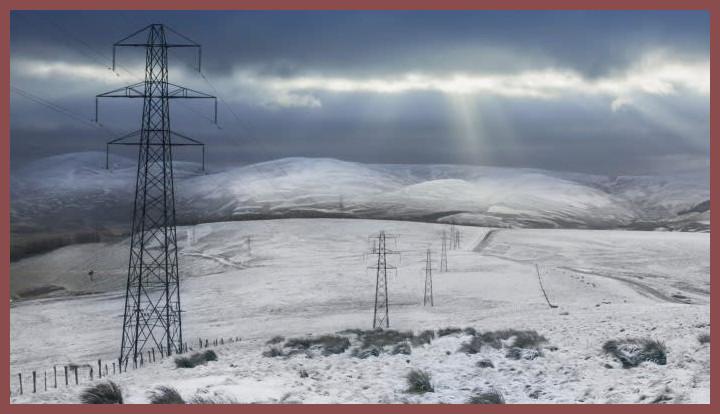
In the picturesque expanse of rural Aberdeenshire, where rolling hills meet sky, Alastair Macphie’s family-run food manufacturing plant stands as a beacon of ambition and sustainability. This industrious establishment, renowned for crafting delectable ingredients such as the cherished cookie dough for Ben & Jerry’s ice cream, is fervently pursuing a greener future. Plans are afoot to construct a solar farm, harmonizing with existing wind turbines, while green hydrogen boilers are under exploration to catapult the company toward its ambitious target of carbon neutrality by 2030.
Yet, an unforeseen threat looms on the horizon—a proposed route for overhead pylons that could mar the serene landscape and compromise the very essence of Macphie’s future plans. The specter of these pylons casts a long shadow over the livelihoods of the 240 dedicated employees who call this place home.
Macphie’s narrative is but a single thread in the intricate tapestry of local resistance against the UK government’s ambitious push for a vast network of overhead lines in the north, a venture deemed crucial for achieving a staggering 55GW of offshore wind energy by 2030. The Scottish and Southern Electricity Networks (SSEN), a subsidiary of energy giant SSE, has embarked on a series of consultations, fanning out into village halls across the region, as part of a massive grid upgrade—an endeavor that underpins the UK’s path to achieving net-zero emissions.
“If SSE persist with their proposed pylons, it would shatter many of our strategic plans, particularly after we’ve just poured £10 million into modernizing our operations,” lamented Macphie. He expressed deep concern that the suggested route would not only place up to eight intrusive pylons on his land, disrupting a fragile ecosystem and a peregrine falcon nest, but also jeopardize the vital water supply to the plant. “Their indifference to these impacts is disconcerting,” he added.
In the Highlands, a battleground is emerging amid the frantic race for net-zero emissions, where the abundant wind farms stand tall against a backdrop of growing rural discontent. The local resistance, fueled by fears of a despoiled landscape and declining property values, is passionately advocating for underground or subsea cables—an elegant solution to ferry Scotland’s excess renewable energy to the energy-hungry realms of England.
For SSE and the UK government, these renewable projects are not mere progress markings; they’re seen as vital players in the grand task of reconfiguring the UK’s energy mix away from its fossil-fuel past. But the path ahead is littered with contention. Opposition is mounting against these towering structures, with activists holding firm against what they deem the industrialization of their cherished landscapes.
Sir Keir Starmer, the Prime Minister, has taken a pragmatic stance, arguing that the expense of burying cables underground makes overhead pylons an unfortunate yet necessary trade-off for sustainable energy. Energy Secretary Ed Miliband has likewise declared his commitment to safeguarding green infrastructure from what he calls “obstructionists,” branding the issue as one of national security.
One pivotal project, the Kintore-Tealing 400kV connection, is set to feature colossal pylons, averaging a height of 57 meters, stretching 105 kilometers across exquisite potato fields and the precious Braes of the Mearns, all the way to the proximity of Dundee.
Tracey Smith, co-founder of the “Save Our Mearns” campaign, articulated a collective sentiment: “While we affirm the need for effective infrastructure, these enormous pylons are an affront to our landscapes and our way of life.” Her words echo the sentiments of many who believe that the rush to decarbonize has overlooked the importance of thoughtful planning and local ecology.
As campaigners gear up to challenge the proposals through legal avenues, there’s an undercurrent of anxiety about whether their voices will resound through the bureaucratic labyrinth. SSEN maintains that they are committed to “meaningful consultation,” adapting routes based on community feedback, and claiming that their overhead lines represent a major step toward meeting climate objectives.
However, geographical limitations restrict offshore solutions, and SSEN argues that overhead lines can transmit nearly three times as much power as subsea cables—while simultaneously keeping energy costs in check for consumers.
Amidst the sprawling green energy projects sprouting across the Highlands, there remains a palpable tension—an escalating community outcry against rising pylons juxtaposed against governmental aspirations for a cleaner, greener future.
In a recent turn of events, Conservative councillor Helen Crawford rallied support for increased public engagement in the planning process, advocating for transparency and a collective overview of renewable applications that seem to pose a daily threat of disruption. Backed by 62 community councils, her motion aims to thwart the “salami-slicing” tactic of piecemeal applications that obscures a holistic understanding of the impending transformations.
With the urgency of the climate crisis pressing down, Scottish officials are prodding for planning reforms to circumvent burdensome local inquiries. Ivan McKee, Scotland’s public finance minister, emphasized the paramount importance of erecting crucial infrastructure for the net-zero goal.
Executives are strategizing to instate time-limited consenting periods, hoping to streamline the process of securing approvals and enhancing Scotland’s competitive edge for investments in green energy. Nick Winser, the UK’s electricity network commissioner, has previously highlighted a pressing need to align Scotland’s consenting system with that of England’s Planning Act, urging rapid amendments to the outdated Electricity Act of 1989 to support energy-targeted projects by 2030.
Once a point of contention, the Beauly-Denny line, another grid expansion initiative, is now a historical lesson learned through a drawn-out public inquiry that concluded about a decade ago.
Anticipation is rife for consultations regarding these reforms this autumn. Stephen McKellar from Scottish Renewables speaks of a plan to articulate the benefits of reinforcing infrastructure, recognizing that engagement and transparency must commence early in the dialogue.
Yet, as questions swirl about the effectiveness of consultations, local residents express deep frustration, feeling as though their concerns have been summarily disregarded. They view the recent engagements as too little, too late, as SSE has had to employ security personnel for protection at these events due to past instances of “threatening and aggressive behavior.”
In Drumlithie, where resolve meets resignation, the despondent mood is almost palpable. Zoe Archer, a long-time resident facing the potential upheaval of her tranquil life, found herself brought to tears upon viewing plans for the pylons that would rise ominously behind her home. “I feel a profound sense of dread,” she confided, grappling with the implications for her property, fearing it may be rendered unsellable due to the looming behemoths. “We simply cannot afford to relocate,” she remarked, reflecting the anxieties that are increasingly shared among her neighbors.