

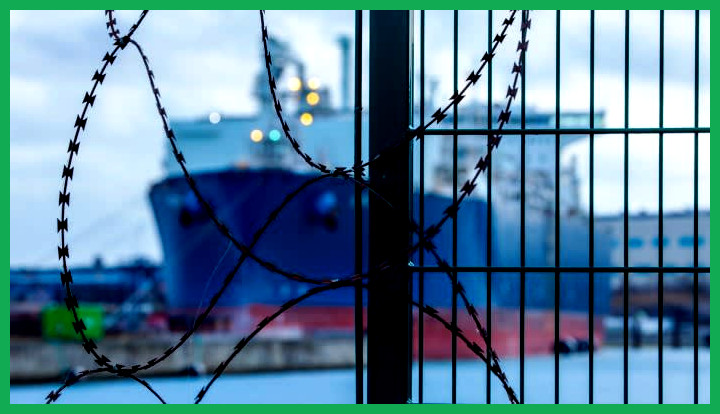
In a move that ripples through the complex fabric of European energy politics, Paris has issued a clarion call for greater accountability among companies handling shipments of Russian gas at EU ports. The specter of increased Russian fossil fuel imports looms ominously over the continent, prompting France, alongside a coalition of nine other nations—most notably Austria and the Czech Republic—to craft a detailed proposal ahead of Tuesday’s critical meeting of EU energy ministers.
This pivotal document implores the European Commission to mandate that suppliers of Russian liquefied natural gas (LNG) make their identities unmistakably clear upon the unloading of their cargoes at European ports. Furthermore, the push for enhanced transparency regarding import volumes emerges as a vital component of this initiative. Compounding the urgency, the document underscores that certain gas suppliers, having secured capacity for incoming Russian LNG, remain inadequately identified—a gap that sow confusion and complicates accountability.
On Tuesday, France’s energy minister, Agnès Pannier-Runacher, emphatically called for what she termed the “highest level of transparency regarding flows of [LNG]” in a bid to sever the dependency on Russian gas. Indeed, contrary to the EU’s ongoing battle to diminish reliance on Russian fossil fuels, stark statistics reveal that imports surged by 11% year-on-year in the first half of 2024, as reported by the Institute for Energy Economics and Financial Analysis.
Intriguingly, the numbers reveal a striking concentration of imports, with the trio of France, Spain, and Belgium claiming a staggering 87% of Europe’s Russian LNG imports during this timeframe. France’s intake notably more than doubled, while Belgium saw its imports drop by 16%. Belgium, a vocal advocate for stringent EU sanctions on Russian LNG, revealed in a separate document that it is devising a mechanism to trace the origin of LNG—a critical step that could facilitate the tracking and potential restriction of Russian LNG molecules if deemed necessary.
Once these gas consignments breach EU borders, tracing their ultimate destination becomes a labyrinthine task, complicated by the blending of various gas sources and the shadowy nature of commercially sensitive contracts. Belgium insisted that any EU nation receiving Russian gas shipped through its ports must substantiate the necessity of such shipments for its energy security, advocating for coordinated efforts from the European Commission.
However, Hungary’s persistent defiance poses a formidable barrier to the EU’s endeavors to curtail Russian fuel flows, with Budapest actively resisting sanctions while seeking to extend its existing contracts with Gazprom, the Russian gas behemoth. Just last Thursday, Hungary inked a deal with Gazprom to sustain gas flows along the vital Turkish pipeline route, underscoring the country’s commitment to maintaining this energy lifeline.
Additionally, Russian gas finds its way into the EU through Ukraine, a path seemingly defiant of the ongoing conflict due to a transit contract poised to expire at the year’s end. The question of extending this contract remains a “very sensitive issue,” as noted by a senior European official, who emphasized the financial significance of transit revenue for Ukraine.
Germany’s state secretary for economic affairs and climate policy, Sven Giegold, expressed alarm over the recent uptick in Russian fuel imports, arguing that the Commission should develop a comprehensive roadmap aimed at reducing all Russian fuel imports to zero.
This anxiety arises in the aftermath of the EU’s initial efforts to curtail Russian LNG access by sanctioning transshipments—essentially re-exporting Russian fuel to third nations—from EU ports, a measure implemented in June. Yet, countries such as the Netherlands have voiced concerns that this ban might inadvertently exacerbate shipments into the EU, as they eliminate the potential for re-exports elsewhere, with the official enforcement of the ban still months away.
Adding to the ongoing discourse, TotalEnergies, a prominent French energy entity and importer of Russian LNG, maintained that it continues to fulfill its long-term contractual obligations with Russia’s Yamal LNG plant. The company clarified that these “take or pay” contracts are binding, only subject to suspension in the event of explicit government sanctions.
Thus, as Europe grapples with the intricacies of energy dependence and geopolitical maneuvering, the quest for clarity, accountability, and ultimately, autonomy from Russian fossil fuels takes center stage. The road ahead remains fraught with challenges, and the concerted efforts of member nations will be crucial in navigating this intricate landscape.