

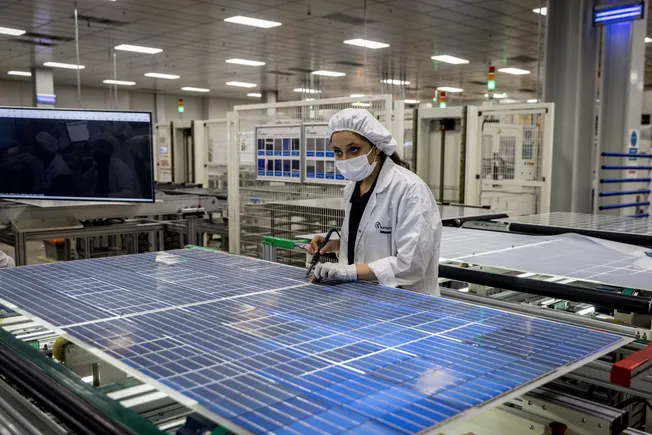
Corning’s new factory in Michigan for silicon ingot and wafer production is now operational, making it possible for the United States to create every key part of the solar supply chain, according to the Solar Energy Industries Association (SEIA).
Since late 2024, U.S. manufacturing capabilities have noticeably grown in all major areas of the solar and storage supply chain. Recently, the United States has exceeded a domestic solar module production capacity of 60 gigawatts (GW), marking a 37% increase from last December.
SEIA indicated that the rise in production of solar modules has contributed to a robust demand for upstream manufacturing. They’ve noted that solar cell production capacity has more than tripled, growing from 1 GW to 3.2 GW since late 2024.
Hemlock Semiconductor and Corning announced the establishment of the ingot facility last October, shortly after the U.S. Treasury clarified that solar ingot and wafer production would qualify for a 25% investment tax credit under the CHIPS and Science Act.
Corning’s CEO, Wendell Weeks, mentioned during a recent earnings call that they anticipate increasing their wafer production from thousands to over 1 million daily. He expressed enthusiasm about their substantial customer commitments, covering more than 80% of their capacity for the next five years.
Weeks also emphasized that the company aims to position itself as a low-cost producer while operating from the U.S.
According to SEIA, the U.S. solar manufacturing sector now boasts a pipeline that includes 23 GW of solar module capacity, over 34 GW of solar cell capacity, 25 GW of inverter capacity, and 95 GWh of battery cell capacity. Manufacturing of solar inverters has surged by nearly 50% since last year, jumping from 19 GW to 28 GW.
In addition, production of mounting systems has grown by 14%, with 23 new factories established since last year, according to SEIA.
However, SEIA expressed concerns that some policies and trade actions from the Trump administration might introduce uncertainty that could hinder the growth of domestic demand and manufacturing in the future.