

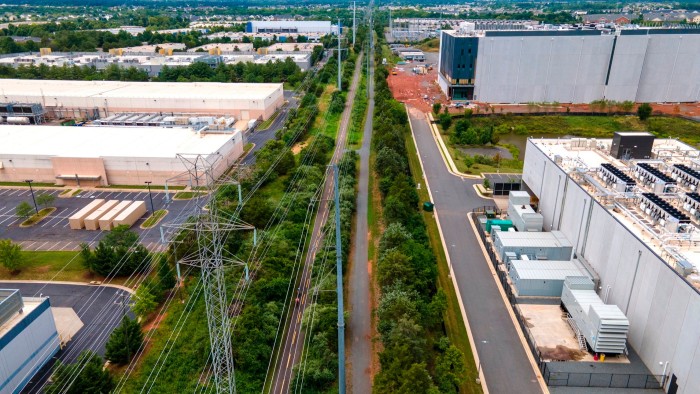
Welcome to the latest update from the Energy Source newsletter, with insights directly from New York.
The nuclear energy sector is experiencing significant financial support driven by the rising energy demands linked to artificial intelligence (AI) data centers. Recently, developers of compact nuclear reactors have successfully raised over $1.5 billion in private funding over the past year, alongside substantial financial backing from governments. However, there are various hurdles — technical, regulatory, and financial — that they need to overcome before these reactors can be operational, likely around 2030.
While nuclear energy is favored by large technology firms, there are alternative solutions to meet the growing energy needs.
In this edition of the Energy Source newsletter, we explore a report from the Rocky Mountain Institute (RMI). This report sheds light on how it is possible to establish data centers without causing significant spikes in electricity prices.
Strategies for Reducing Electricity Costs amid the AI Surge
The push for the U.S. to take the lead in AI has raised concerns over potential financial impacts on consumers, as the massive energy consumption of these data centers inches the nation closer to power shortages. However, the RMI report indicates that it is feasible to develop AI data centers without leading to immediate increases in electricity costs.
Specifically, RMI’s findings reveal that by constructing a data center adjacent to a new renewable energy source and near an existing gas plant, we can expedite the introduction of new electricity supplies. This approach also protects families and businesses from rising electricity expenses.
By locating renewable projects near gas plants, we can bypass the lengthy wait times associated with hooking up to the grid, which can average around five years, as per the Lawrence Berkeley National Laboratory.
This pairing of energy sources, referred to as “power couples,” could support more than 30 gigawatts of fresh data center demand without exceeding $100 per megawatt-hour, with Texas, the mid-Atlantic, and the southeastern U.S. having the highest potential.
In November, average wholesale electricity prices in the U.S. varied significantly, reaching $64.21/MWh in New England while resting at just $12.50/MWh in Texas, based on data from the U.S. Energy Information Administration.
The data center would finance protective measures to keep its energy supply independent, ensuring that it does not impose additional costs on the power grid or on other consumers.
“This is a way to swiftly bring renewable projects online in a manner that supports a critical industry without costs being shifted to other customers,” explained Mark Dyson, managing director of the carbon-free electricity program at RMI.
The RMI report arrives in a context where the surge in demand for AI data centers is contributing to an unprecedented rise in electricity consumption in the U.S. This spike in demand threatens to elevate energy prices and hinder efforts to decarbonize the electricity sector.
Currently, U.S. power demand is at an all-time high and is projected to increase by 16% by 2029. A previous report from consultancy ICF anticipated that rising power demands could lead to nearly a 20% hike in wholesale electricity prices from 2025 to 2028.
In response to these challenges, several state legislatures, including those in New York, Virginia, and Oregon, have introduced or considered laws aimed at regulating the energy consumption of data centers to safeguard consumers from increasing costs.
Last year, a proposal to expand the capacity of a Pennsylvania nuclear plant to power a data center was turned down by the Federal Energy Regulatory Commission, citing concerns about grid reliability and consumer costs.
Typically, data centers use between 5 and 10 megawatts of power. However, the energy demands for AI have resulted in the need for significantly larger data centers, which the International Energy Agency estimates could require around 100 megawatts or more.
Giordano Albertazzi, the CEO of Vertiv, a company that provides energy solutions for data centers, noted that past data centers heavily depended on the grid. “This increasing demand for power is prompting data center operators to seek out innovative solutions,” he said.
In California, where utility rates are among the highest nationally, Patricia Poppe, CEO of Pacific Gas and Electric, mentioned that revenue generated from data centers has allowed them to reduce rates for local residents. “As we manage their growing needs, it helps to lower costs for our broader customer base,” Poppe stated, noting ongoing investments in transmission, renewable energy, and storage alternatives to meet the anticipated 5.5 gigawatts of new demand over the next decade.
To address the rising electricity demands, leading tech companies like Amazon and Microsoft are investing in nuclear energy. Nonetheless, the nuclear sector still faces various challenges concerning technology, approvals, and finances, which could delay project timelines. RMI indicated that the power couple model could deliver necessary supply within one to two years, which would especially benefit companies eager to expedite their developments.
However, challenges remain for RMI’s proposed solutions. Dyson emphasized that while this approach is viable in Texas, other regions may not share the same flexibility due to regulatory constraints. “This presents a fantastic opportunity for the U.S. to support a vital industry while doing so in an economically wise and environmentally friendly manner,” he added, suggesting potential shifts in regulatory frameworks at both federal and state levels to facilitate the power couple model across the U.S.
Job Updates in the Energy Sector
Jigar Shah, former director of the U.S. Department of Energy’s Loan Programs Office, has taken on a role as a part-time venture partner with Powerhouse Ventures.
John Emery has been appointed as vice president of North America sales and business development at CTC Global, coming from Trachte.
Chad Richards has transitioned from Kirkland & Ellis to become a partner in Mayer Brown’s global energy group.
David Hill, previously the general counsel at the U.S. Department of Energy under George W. Bush, is now the executive vice president of energy at the Bipartisan Policy Center.
Chris Miller has joined Lazard as managing director in their power, energy, and infrastructure advisory business after serving as managing director at Citigroup.
Michael Buker has become the chief executive of Phoenix Technology Services, succeeding John Hooks, who will now serve as the executive board chair.
- Oil and gas exploration company Helios Energy has named Edward May as their new chief financial officer.
These shifts highlight the ongoing evolution within the energy sector as it adapts to the changing landscape of energy production and consumption.