

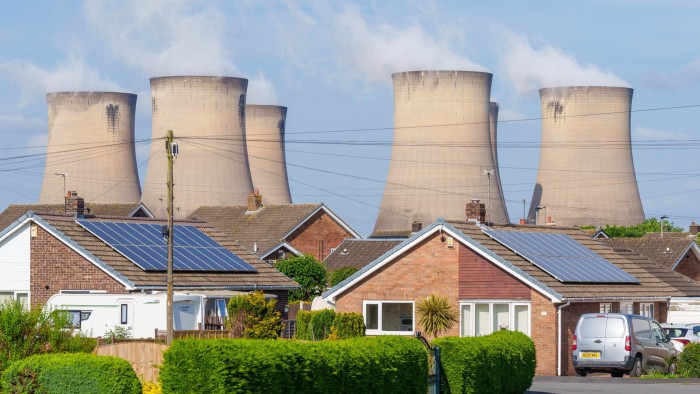
The Drax power station, a significant landmark in North Yorkshire near Selby, has secured its future for several more years. This week, it was announced that the biomass plant, which features 12 cooling towers, will continue operations until at least 2031, thanks to renewed backing from the government.
Originally constructed as a coal-fired plant in 1974, Drax has since transitioned to burning wood pellets. Despite its longevity, the plant faces criticism from various groups, including environmental activists and even the Conservative party, which distanced itself from Drax after leaving office last year. Greenpeace has labeled the plant a “subsidy-burning scam,” further intensifying the scrutiny it faces.
The recent announcement of continued support for Drax was made by energy minister Michael Shanks, as energy secretary Ed Miliband did not attend the event. Shanks expressed disappointment about the “energy inheritance” left by the Conservatives and indicated that from 2027, Drax would operate with significantly reduced public funding.
This compromise feels painful but necessary. While Miliband aims for Britain to transition to clean electricity by 2030, the emissions from burning wood pellets at Drax cannot simply be overlooked. Nevertheless, Drax’s existing infrastructure stands in contrast to the new nuclear power stations the government is exploring as part of the energy transition, making it a player that cannot be overlooked for now.
Following the announcement, shares in Drax Group, the company behind the power station, saw an uptick as the market reacted with relief, even as doubts linger regarding Miliband’s energy plans. Experts warn that substantial and complex investment is required to enhance the electricity grid and push fossil fuel generation to lower levels, suggesting Drax will have a role for the foreseeable future.
Drax plays a unique role in the regulatory landscape, benefiting from a peculiar arrangement that allows its biomass generation to be classified as zero-emission under UK and European carbon standards. The wood pellets, primarily sourced from North America, count as renewable energy, despite Drax having higher emissions than other UK power plants, according to findings from research group Ember. Furthermore, the plant was fined last year for not maintaining sufficient data on its sourcing.
Critics argue that such environmental loopholes are losing their appeal. Drax defends its practices by asserting that the carbon released is offset by the regrowth of trees used to produce the pellets. Even so, it’s unrealistic to ignore these emissions entirely. Biomass energy should be recognized as a middle ground between truly green sources like wind power and fossil fuels.
However, the case against Drax is not strong enough to warrant shutting it down. Ending support for the plant would jeopardize about 5 percent of the UK’s future energy capacity and increase reliance on gas and nuclear plants during periods when solar and wind energy is lacking.
Wind energy accounted for 30 percent of the UK’s electricity last year, but the continued growth of this renewable source does not eliminate the need for gas and biomass plants that can be activated as needed. In fact, as the energy system becomes more decarbonized, its reliability may be more vulnerable if these plants lose their business to cheaper energy alternatives.
A decarbonization study from the National Engineering Policy Centre last year indicated that the UK may indeed need to invest in additional gas-fired plants to maintain energy generation capability moving forward. The National Energy System Operator has echoed this sentiment, pointing out that the current pace of energy transition is reaching its limits and highlighted the need for Drax to remain operational for energy security reasons.
Acknowledging these points, the government’s recent agreement appears to treat Drax more like a gas generator than a conventional renewable energy source. While the plant will still be functional, it will operate under reduced capacity, with provisions in place to recover any excess profits.
Looking ahead to March 2031, when the current agreement is anticipated to conclude, Drax has plans to implement carbon capture and storage technology to eliminate greenhouse gas emissions and participate in trading emissions credits. However, this technology remains untested and costly, though Drax has shown to adapt proactively to the evolving energy landscape.
Given the developments of this week, it seems likely that delays will continue regarding the implementation of carbon capture technology, as well as achieving Miliband’s clean energy objectives. While having a visionary plan is commendable, abruptly closing a power station that faces criticism could lead to serious energy shortages.