

The Department of Energy (DOE) recently kicked off a new research and development initiative focused on superhot rock geothermal energy. This energy source is largely untapped but has significant potential—if just 1% of its capacity were utilized in the U.S., it could generate around 4.3 terawatts of reliable power, as highlighted by the Clean Air Task Force.
To get the ball rolling, the DOE’s Advanced Research Projects Agency-Energy (ARPA-E) is providing $30 million in funding for its new program called SUPERHOT, which stands for Stimulate Utilization of Plentiful Energy in Rocks through High-temperature Original Technologies. This program aims to create access to geothermal reservoirs capable of generating between 10 and 20 gigawatts of baseload power in a cost-effective manner. Currently, the United States has an estimated 4 gigawatts of conventional geothermal capacity.
Under the SUPERHOT initiative, the DOE aims to develop geothermal well construction techniques that can endure for at least 15 years. These wells will be designed to transfer heat from the surrounding rocks to the well itself. The focus will be on tapping into resources with temperatures exceeding 375 degrees Celsius and pressures over 22 megapascals.
However, the journey toward successful superhot rock geothermal energy production is not without its hurdles. The extreme conditions, like high temperatures and corrosive fluids under pressure, pose significant challenges as noted by ARPA-E.
Globally, about 20 boreholes have been drilled vertically and near-vertically to depths of up to five kilometers, reaching temperatures as high as 500 degrees Celsius. Unfortunately, most of these wells have failed quickly, with none currently producing power.
Terra Rogers, the director for Superhot Rock Geothermal at the Clean Air Task Force, emphasized the importance of this program, stating that it is crucial for overcoming technical obstacles and advancing the commercialization of superhot rock geothermal energy at a satisfactory pace.
This new program is built on ARPA-E’s earlier support for enhanced geothermal power technologies, which benefitted industry leaders such as Fervo Energy, AltaRock Energy, and Eden Geopower.
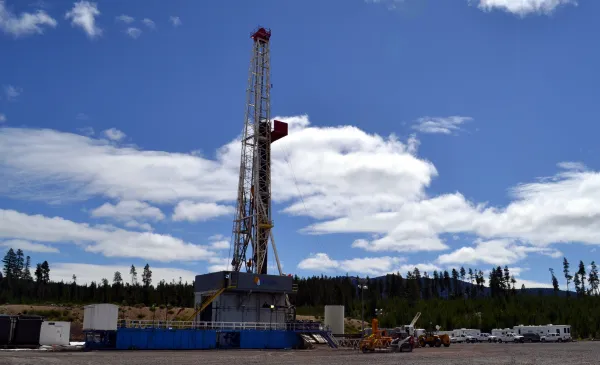
In a recent move, the DOE awarded a grant to Mazama Energy to help with a superhot rock geothermal demonstration project located near Bend, Oregon. This three-year project will utilize hydraulic stimulation techniques, combining methods of hydraulic fracturing and shearing. The region, specifically around the Newberry Volcano, is believed to have an impressive geothermal potential of up to 10 gigawatts according to AltaRock Energy, one of the founding companies of Mazama.