

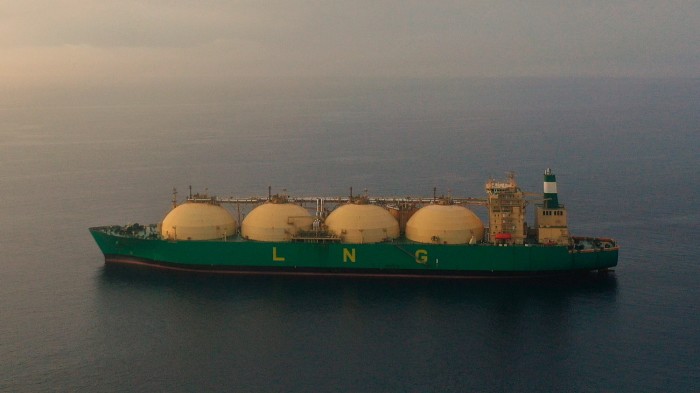
The world’s largest oil companies are likely to see a decrease in their liquefied natural gas (LNG) revenues this year. This decline comes as the market stabilizes after a period of high volatility that had boosted profits following Russia’s invasion of Ukraine in February 2022.
Since the conflict began, LNG trading volumes have surged to new highs, as this super-chilled fuel has replaced much of the gas that traditionally flowed from Russia to Europe via pipelines. However, analysts predict that revenues from LNG trading, which largely depend on price fluctuations, will begin to drop in 2025 as the market returns to a more steady state after the instability caused by the invasion and the resulting energy crisis.
This change is anticipated to impact major oil corporations, including Shell, BP, TotalEnergies, ExxonMobil, and Chevron. All five have extensive LNG operations that have profited significantly from the extreme price shifts that led to record earnings in the sector.
A trader in the LNG market noted that volatility has been decreasing in recent months, starting the year at levels lower than both last year and 2022:
“The argument about volatility is very important. In a calmer market, regardless of how skilled your traders are, making substantial profits becomes more challenging.”
The Title Transfer Facility, which serves as a primary gas benchmark in Europe for LNG contracts, experienced significant price swings in 2022, reaching highs of over €300 per megawatt hour and lows of €65/MWh. In 2024, this fluctuation is expected to narrow further, with prices projected to range from €50/MWh to €22/MWh.
According to forecasts from Citi, LNG revenues will constitute a significant part of cash flows for these companies this year, with Shell expected to derive 21% of its cash flow from LNG, Chevron 18%, TotalEnergies 14%, ExxonMobil 12%, and BP 10%.
Some groups predict a looming oversupply in the LNG market, which could further push prices down. Rystad Energy forecasts that by 2027, supply will surpass demand, a trend expected to continue as more projects in the United States come online and Qatar increases its production.
Shell, already the largest LNG player outside of state-run companies, indicated in a recent trading update that it anticipates a decline in LNG volumes in the last quarter of 2024 compared to previous months.
To prepare for the expected oversupply, major corporations like Shell and TotalEnergies are shifting their contracts away from dependence solely on gas prices to a model tied to oil prices, as explained by Christopher Kuplent, a research analyst at Bank of America. Shell’s CEO Wael Sawan also expressed confidence that the LNG sector will remain profitable even if prices fall over the coming years.
Despite the current calm in the market, experts caution that political uncertainties continue to harbor risks for the LNG sector’s stability. Frank Harris, head of global LNG consulting at Wood Mackenzie, remarked on the unpredictable geopolitical landscape and its potential impacts on the LNG market.
While BP and Shell chose not to comment on their anticipated LNG revenues, representatives from TotalEnergies, ExxonMobil, and Chevron did not respond to inquiries.