

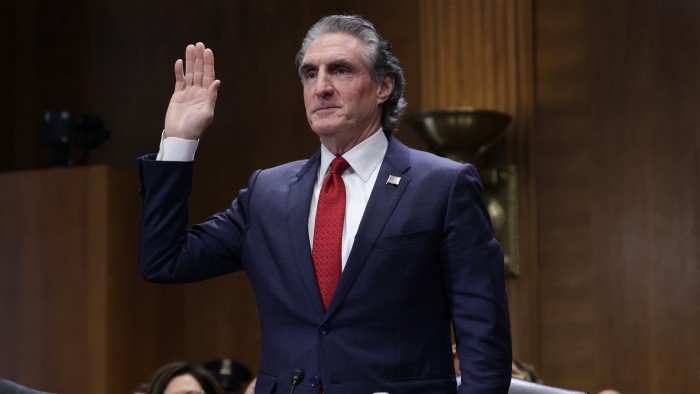
Donald Trump’s nominee for secretary of the interior, Doug Burgum, has raised concerns that the U.S. could fall behind China in the “AI arms race” if it doesn’t increase its electricity generation from fossil fuels. During a Senate hearing on Thursday, Burgum, a billionaire and former governor of North Dakota, described a current “electricity crisis,” citing issues with the power grid and obstacles that prevent the construction of fossil fuel plants that offer consistent power.
Burgum emphasized that the Trump administration would focus on providing more public land for oil drilling and would cut tax breaks for renewable energy sources, which he claims provide unreliable power. “The sun doesn’t always shine and the wind doesn’t always blow,” he stated, expressing his belief that the energy balance in the U.S. is currently misaligned.
The demand for electricity in the U.S. is increasing rapidly, especially due to the growing needs of data centers for artificial intelligence tasks. The Department of Energy has projected that this demand will triple over the next three years.
Burgum warned that without a reliable base power supply, the U.S. risks losing its competitive edge in AI to China, which could have serious implications for national security. He criticized the current regulatory environment for creating barriers to stable electricity production while favoring incentives for less reliable energy sources.
If he is confirmed as Trump’s “energy tsar,” Burgum will have significant authority to implement the president-elect’s energy policies. Recently, President Biden signed an executive order aimed at developing federal land for AI infrastructure, which mandates the use of clean energy.
Burgum noted that new technologies like carbon capture could potentially mitigate emissions from fossil fuels, although he acknowledged some skepticism about their practicality. He also argued that cutting U.S. fossil fuel production would not benefit the environment, as it would merely push production into countries with less concern for ecological standards.
He asserted, “America produces energy cleaner, smarter, and safer than anywhere in the world.” According to him, restricting U.S. energy production would not lessen demand; instead, it would transfer production to countries with poor environmental records, such as Russia and Iran.
The U.S. is anticipating a significant increase in natural gas-powered facilities, with around 80 expected to start operating by 2030. Biden’s climate initiatives, including the Inflation Reduction Act, linked offshore oil and gas leases to the development of offshore wind projects. Burgum refrained from commenting on whether he would protect these wind projects, while Trump has pledged to halt them immediately upon taking office.