

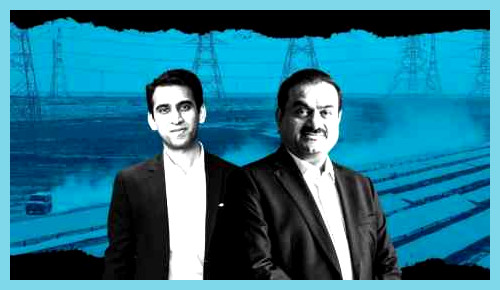
Indian billionaire Gautam Adani is facing serious legal trouble as US prosecutors have charged him in a case involving a longstanding scheme to bribe Indian officials. This alleged plot was aimed at securing beneficial solar power contracts worth over $2 billion in profits.
On Thursday, shares of Adani Group’s companies fell sharply after the indictment of the 62-year-old businessman, a major backer of Indian Prime Minister Narendra Modi. The charges against him include securities fraud, and he was indicted in New York along with seven co-defendants, including executives from Adani’s energy branches and a few ex-employees of a Canadian pension fund.
Among those charged is Sagar Adani, Gautam’s nephew, who serves as the executive director at one of his renewable energy companies.
US authorities allege that more than $250 million in bribes were promised between 2020 and 2024 to Indian government officials, with the intention of hiding these dealings from US banks and investors that funded their operations.
According to the prosecution, Gautam Adani himself met with Indian officials to facilitate this scheme. Additionally, they have charged three former employees of the Canadian pension fund CDPQ for obstructing an investigation by deleting emails and providing misleading information to US authorities. CDPQ, which invests in various infrastructure projects, holds shares in Adani’s businesses.
These legal actions could reignite the scrutiny surrounding Adani Group, which has been attempting to recover from previous allegations of accounting fraud and stock price manipulation made by the US short seller Hindenburg Research. Adani has consistently denied any wrongdoing.
Following the news, stocks of his ten listed companies experienced significant declines, with Adani Enterprises falling by 22%, its ports division dropping 14%, and Adani Green Energy decreasing by 19%.
Lisa Miller, a deputy assistant attorney general in the US, stated that the indictment outlines accusations involving more than $250 million paid in bribes to Indian officials, all conducted by senior executives to secure government energy contracts through corrupt practices, ultimately harming US investors.
The prosecutors also claimed that the accused extensively documented their corrupt actions using mobile devices, presentations, and spreadsheets which detailed bribes and how to conceal them.
In a related civil complaint, the US Securities and Exchange Commission (SEC) alleged that these bribes were meant to ensure commitments from the Indian government to buy energy at prices favorable to Adani Green and Azure Power, both active players in India’s renewable energy market.
Adani Green is currently developing one of the world’s largest solar power facilities in Gujarat and had previously secured over $175 million from American investors while the alleged bribery scheme was still active.
Both Gautam and Sagar Adani are accused of enticing US investors into purchasing bonds from Adani Green by falsely claiming that the company had a strong anti-bribery compliance program and that management had not engaged nor would engage in bribery.
The Adani Group responded to these accusations by calling them unfounded and indicated that they would pursue all possible legal avenues to contest the charges.
Meanwhile, CDPQ mentioned that it is aware of the charges against former employees who have since been terminated and that it is cooperating with US authorities regarding the matter.
In recent developments, Gautam Adani had expressed commitment to invest $10 billion in US energy security and infrastructure projects while reaffirming his group’s dedication to leveraging global expertise.
Adani’s business expansion aligns with India’s broader initiative to engage private sectors in infrastructure development, particularly under Modi’s government.
The opposition in India is demanding an inquiry into the circumstances surrounding Adani’s contracts and his close associations with political figures like Prime Minister Modi. Following the recent indictments, Congress leader Rahul Gandhi has reiterated calls for a parliamentary investigation.