

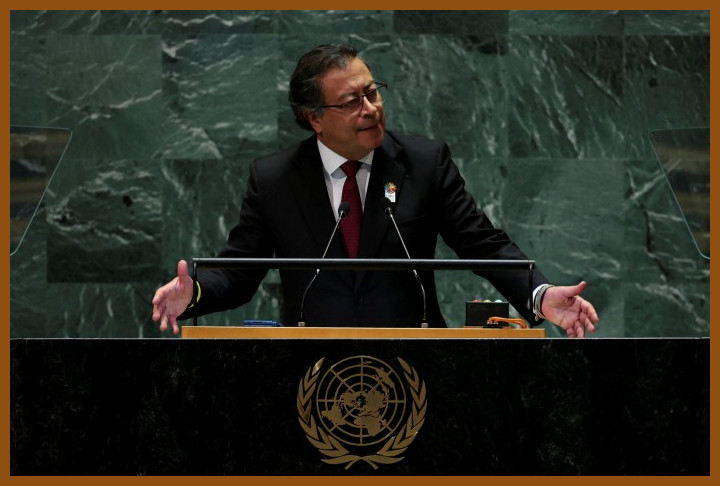
Colombia has been working hard to move away from fossil fuels since the election of its first leftist president, Gustavo Petro, over two years ago. However, transitioning to sectors like agriculture, tourism, and renewable energy has proven to be a challenging task.
Andrés Camacho, the country’s minister of mines and energy, emphasizes the need for economic diversification, stating, “Without a doubt, in order to substitute the revenues from fossil fuels, the economy must be diversified.”
Under President Petro’s leadership, Colombia has halted new oil drilling and exploration contracts and, in a historic move, was the first major oil and coal producer to join the Fossil Fuel Non-Proliferation Treaty, aiming for a reduction in fossil fuel extraction.
Despite these efforts, oil and coal exports still account for approximately 50% of Colombia’s export revenues, generating about $24.7 billion last year. In comparison, tourism and agriculture, although growing, brought in around $17.5 billion—reflecting a significant gap. Although the tourism sector has seen a growth of 12.8% since 2022 and is worth $7.4 billion, it has a long way to go to match the income generated by fossil fuels.
Some experts question the wisdom of the government’s strategy, especially during a time when oil prices are relatively high. Countries like Brazil and Guyana are investing in both fossil fuel and renewable initiatives concurrently. Former finance minister Juan Carlos Echeverry argues that balancing both oil and gas with developing tourism and agriculture is entirely feasible. He highlights, “I don’t see that there is a dilemma, as both things can be done, as they are in the US and Brazil.”
The economic landscape in Colombia appears to be slowing. Growth forecasts for this year sit at 1.9%, lower than the IMF’s regional estimate of 2.1%. Inflation has also risen, hitting 6.1% in September. To address these economic challenges, Petro intends to release a national spending plan for 2025 by decree, following disputes with lawmakers over budget issues.
On a more positive note, agricultural exports are expected to rise 8% this year after a decline in 2023. Petro, who has been known for his critical views of the private sector, aims for Colombia to reach net zero emissions by 2050 and sees potential for the country as a green energy exporter.
Currently, 66% of Colombia’s electricity comes from hydropower, while fossil fuels account for 32%, and wind and solar energy makes up the remaining 2%. The government predicts that by 2027, the energy mix will consist of 50% hydro, 26% wind and solar, and 24% fossil fuels. Notably, 85 solar farms have been commissioned in the past year, according to Camacho.
However, critics point out the government’s struggle to effectively collaborate with renewable energy companies, particularly when engaging local communities. Italian utility Enel faced challenges last year and ended its plans for a significant wind farm after failing to reach agreements with indigenous communities over land use.
Eugenio Calderón, head of Enel Green Power in Colombia, stressed the importance of economic and social sustainability in energy projects. The abandoned wind project was designed to contribute 205 MW to the national grid but remains unfinished due to these issues.
Yet, there is some progress. Grupo Energía Bogotá, primarily owned by Bogotá city, is advancing on connecting wind farms to the grid and is taking lessons from previous experiences. Camacho explains that the government has established better communication with indigenous authorities to ensure sustainable development.
Alexandra Hernández, president of Colombia’s renewables association, believes that diversifying the energy grid is crucial since the current dependence on hydropower makes it susceptible to droughts. The government has warned of potential energy shortages by 2028 without the quick introduction of new projects, suggesting that renewables can help fill that gap.
As companies like Zelestra invest in solar energy, launching a $200 million solar farm capable of generating 100 MW, the regulatory framework has become more inviting for renewable projects. However, delays in permit approvals remain a hindrance. Chiara Gasparrini, Zelestra’s vice-president for business development in Latin America, notes these bureaucratic obstacles, stating, “Often, the time required for permits is not exactly what would be required to make many projects viable.” Nonetheless, efforts are ongoing to enhance the process.