

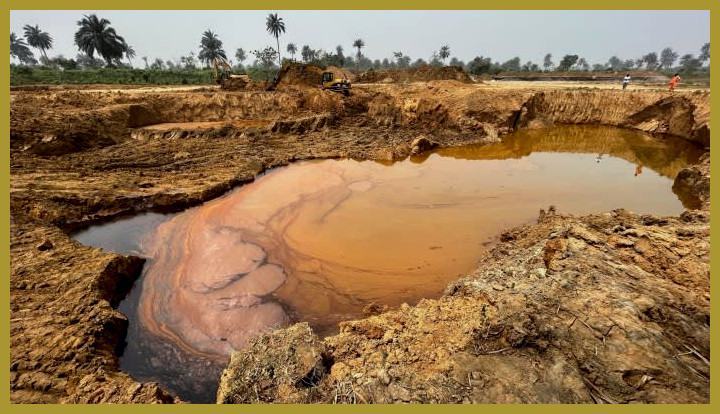
In a striking turn of events, Nigeria has snubbed Shell’s ambitious attempt to offload its onshore oil production unit for a staggering $1.3 billion, a move that significantly hampers the oil giant’s strategy to disentangle itself from the tumultuous shallow waters of the Niger Delta.
During a recent oil conference in Abuja, Gbenga Komolafe, the head of the Nigerian Upstream Petroleum Regulatory Commission (NUPRC), revealed that the proposed sale to Renaissance Africa Energy, a relatively obscure local consortium, failed to pass the necessary regulatory muster. Specifics regarding the regulator’s decision were not disclosed, but Komolafe has previously expressed skepticism regarding Renaissance’s capacity to effectively manage Shell’s extensive assets within Nigeria.
Meanwhile, while the spotlight dimmed on Shell, it unexpectedly illuminated ExxonMobil, which just received the green light for its long-stalled $1.28 billion deal to divest its onshore properties to Seplat Energy, a firm listed in London. This juxtaposition underscores the maze-like challenges and pervasive uncertainties that investors commonly encounter when attempting to withdraw from the Nigerian oil scene.
At the rally, Komolafe confirmed that his agency had finally granted the long-awaited ministerial approval for Exxon’s transaction to move forward. Although Seplat chose to remain silent, it did acknowledge the vital announcement made by the regulator.
Back in January, Shell had triumphantly proclaimed an agreement to divest its interests in Nigeria’s swampy Niger Delta—a region it has operated in for nearly seven decades. The European oil behemoth had been waiting on the country’s oil minister for a nod, a role played by none other than Nigeria’s President Bola Tinubu, who relies on the insights and evaluations provided by NUPRC to inform his decisions.
Over the past two years, major players like Italy’s Eni, Norway’s Equinor, and China’s Addax have similarly moved to part ways with their onshore holdings in Nigeria, motivated by dwindling returns exacerbated by rampant oil theft, violence, and the environmental toll wrought by the industry. The allure of more lucrative offshore ventures has further beckoned oil titans to pivot away from the vulnerable swamps of the Niger Delta.
Exxon and Seplat initially struck their agreement back in February 2022, with Seplat projecting the acquisition would catapult its production nearly threefold—from 48,000 barrels to an impressive 130,000 barrels of crude oil. However, this all-cash deal has remained in limbo, notably after the state-owned NNPC interjected, asserting its preemptive purchasing rights over Exxon’s assets, which are jointly operated under a legal obligation with the NNPC.
Despite the hurdles, former President Muhammadu Buhari had, for a fleeting moment in August 2022, endorsed the deal after weighing its perceived benefits for Nigeria’s energy landscape and broader economy. Yet, mere days later, he retracted his approval, insisting on further regulatory scrutiny.
In a parallel development, Eni’s divestiture of its Nigerian unit to Oando for $783 million was consummated in August, and Equinor found a buyer in Chappal Energies for its subsidiary at an undisclosed price the preceding November. Not resting on its laurels, Chappal Energies also procured a minority stake in a Total onshore operation for a hefty $860 million this year.
Clementine Wallop, a leading figure at Horizon Engage, a consultancy specializing in the sub-Saharan region, heralded the approval of Exxon’s transaction as “uplifting news” for both the Nigerian government and energy investors, marking the end of a protracted wait riddled with uncertainty.
The complexities of Nigeria’s oil narrative continue to unfold, each twist revealing the intricate dance between regulation, corporate strategy, and the ever-changing landscape of energy investment.