

A colossal surge in air conditioning usage is poised to unleash one of the most significant and unpredictable storms on the global electricity grids over the next decade, warns the International Energy Agency (IEA). This alarming forecast underscores a confluence of escalating incomes in developing regions and the relentless rise in temperatures attributed to climate change—factors that together signal a staggering rise in power consumption for domestic air conditioning units, exceeding the current total electricity usage of the entire Middle East.
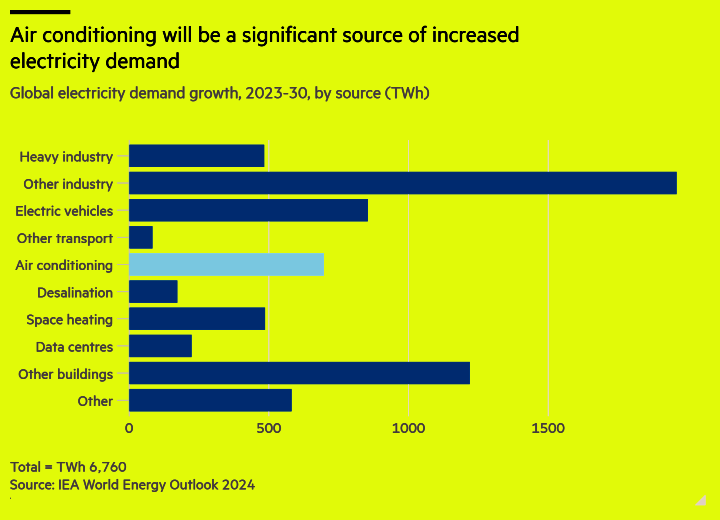
In its latest edition of the World Energy Outlook, released on Wednesday, the IEA has adjusted its projections for electricity demand upward, revealing a 6% increase anticipated by 2035 compared to last year’s estimates. The report highlights that air conditioning alone is expected to gobble up an additional 697 terawatt hours (TWh) of electricity by 2030—a figure that dwarfs the projected extra demand stemming from computer data centers, which is more than three times less. Meanwhile, the insatiable appetite of electric vehicles will demand an added 854 TWh, as detailed by the IEA.
The demand for air conditioning will not only surge but will also introduce a chaotic variability, making its daily impact on electricity grids notoriously unpredictable. “It’s a blind spot for many decision-makers to grasp just how pivotal air conditioning is in the trajectory of global electricity consumption,” remarked Fatih Birol, IEA’s executive director, in a recent interview. To illustrate this disparity, he noted that while 90% of households in the United States and Japan are equipped with air conditioners, the figures drop to a mere 5% in Nigeria, 15% in Indonesia, and below 20% in India. Increasing income levels and the profound influence of climate change are driving consumers toward air conditioning, which is becoming a significant force in energy consumption trends,” he elaborated.
The IEA projects that energy consumption for residential air conditioning is set to skyrocket by 280% by 2050 under a “business as usual” scenario—referred to as “Steps.” By that time, it will represent 14% of total energy demand within buildings, a steep climb from under 7% today. Even in a more optimistic scenario where governments fulfill their climate commitments, energy usage in air conditioning would still see a nearly 200% rise.
Most of this explosive growth in air conditioning demand is expected to manifest in emerging markets and developing economies, with the IEA cautioning that escalating climate change could intensify this demand further, especially during more frequent heatwaves.
Conversely, while energy requirements from data centers will continue to climb, their overall impact on the grids will remain comparatively muted. “With over 11,000 data centers across the globe, their localized concentration means they can significantly impact local electricity markets,” the IEA explained. “However, at the global scale, data centers constitute a relatively modest portion of total electricity demand growth by 2030.”
Global electricity demand, as articulated by the IEA, is escalating at a staggering pace of 1,000 TWh annually, equivalent to integrating another Japan into global electricity consumption each year. Additionally, the forecast for 2035 electricity demand has been lifted by 6%, equating to 2,200 TWh, bringing the total expected demand to a chilling 37,371 TWh.
Birol emphasized the mixed pace of the energy transition, noting that while some locales exhibit a slowdown, others are acceleratively plowing ahead. “Renewable capacity additions this year have exceeded those of 2023 by a robust 20%. I don’t perceive a major deceleration; rather, this momentum appears driven by economic factors rather than climate policies.”
Nonetheless, the agency flagged a rising wave of trade measures aimed at clean energy technologies, with figures swelling from 40 in the previous five-year stretch to almost 200 since 2020. This surge reflects growing trepidation over the dominance of Chinese companies in sectors like solar panels and electric vehicles.
Further complicating the landscape, the World Energy Outlook highlighted the uncertainties surrounding the energy transition trajectory, particularly in light of the impending wave of democratic elections, including the pivotal US presidential election. “Energy and climate-related issues have surged to the fore for voters, increasingly influenced by soaring fuel and electricity prices, alongside devastating floods and heatwaves,” it warned.
Data visualization by Keith Fray