

Welcome back, dear reader.
In the grand theater of energy economics, where titans of American oil reign supreme, a tantalizing vision unfolds—one where these behemoths bask in the glow of unwavering demand and profitability for their fossil fuel offerings, thriving well into the foreseeable future. Yet, lurking in the shadows of this optimistic tableau lies a specter: the rapid advance of the energy transition. Should this transformation occur at a pace more brisk than envisioned, these companies may find themselves hastily shutting down operations, facing the unwelcome prospect of premature asset decommissioning. Regardless of the scenario, a stark financial reality looms large; hefty clean-up expenses await these giants once their fossil fuel ventures reach their inevitable conclusion.
Across the vast Atlantic, European oil enterprises present a treasure trove of information in their annual disclosures, meticulously outlining the assumptions that underpin their evaluations of long-term obligations. These intricacies wield considerable influence on their financial landscapes. In stark contrast, their American counterparts have largely shrouded these details in opacity, raising the eyebrows of international investors who now call for regulatory intervention to illuminate the murky waters of these environmental risks.
Oil and Gas Companies
Investor Coalition Urges US Energy Firms to Unveil Clean-Up Liabilities
At present, the fossil fuel assets of publicly traded American energy firms churn out a steady stream of profits, creating a façade of invincibility. However, the clock is ticking; each asset is on a trajectory toward obsolescence, which will inevitably trigger costly clean-up responsibilities that corporate stewards are legally bound to fulfill.
This mounting obligation casts a substantial financial shadow over US oil and gas entities, one that they have failed to transparently disclose in their public financial statements, critics assert. A coalition of 40 investors — a diverse assembly of UK, European, and American institutions wielding a collective $3.75 trillion in managed assets — has taken the initiative, penning a missive to US regulators demanding clarity on these liabilities.
Among the notable names within this coalition are prominent UK institutions such as Legal & General and Scottish Widows, alongside Danish stalwart AkademikerPension, and a select few smaller US organizations, including the Vermont Pension Investment Commission.
The letter addressed to the Securities and Exchange Commission — unveiled here for the first time — indicates that SEC regulations stipulate the necessity for companies to reveal the estimates and “critical accounting assumptions” that inform their financial statements.
Particularly scrutinized were the liability estimates concerning the mandated clean-up operations tied to abandoned fossil fuel infrastructure. A report from Carbon Tracker published last December estimates that scrapping existing fossil fuel structures in the US could impose a staggering burden exceeding $1.2 trillion.
The investor coalition cautioned that the six largest publicly traded European oil titans, such as BP and TotalEnergies, disclose far more granular details regarding their environmental liabilities compared to the seven most significant US contenders, including ExxonMobil and Chevron.
Across the Atlantic, all studied companies provide some semblance of the projected net present value of their clean-up obligations. Yet, these figures offer merely a fragmented view of the true financial peril that looms. The present-day calculations hinge upon two pivotal variables: the anticipated retirement date of the asset and the discount rate employed to recalibrate the future liability (underlining the concept that a dollar today surpasses a dollar in the distant future).
A higher discount rate, coupled with a protracted asset retirement timeline, diminishes the apparent present-day clean-up obligation.
The European firms scrutinized offered insights into their expected asset retirement dates, with only Norway’s Equinor refraining from publishing specific discount rate figures, citing their narrative approach in their annual report.
Conversely, among the seven US entities in question, Occidental Petroleum stood out as the only company to divulge any insights into retirement timelines, while none of them revealed their employed discount rates.
Similar disparities arise in the long-term oil price forecasts that underpin their asset evaluations; all European companies share their future price projections, a courtesy that remains absent among their American counterparts.
“It’s a surreal scenario,” remarked Natasha Landell-Mills, head of stewardship at Sarasin & Partners. “The regulations are unequivocal in mandating the disclosure of critical forward-looking accounting assumptions, complete with numerical data.”
Eric Rieder, a partner and securities litigator at the US law firm Bryan Cave Leighton Paisner, pointed to the multifaceted nature of these disclosure regulations, often embroiled in discussions over what constitutes “critical” or “material” information. “Materiality is contingent upon the surrounding facts and circumstances,” he explained.
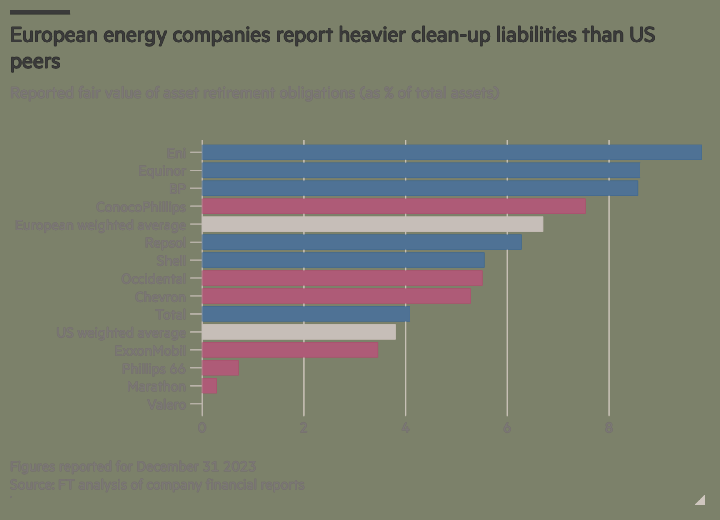
Nevertheless, it is noteworthy that US companies report significantly lower present-day valuations of their clean-up obligations compared to their European counterparts. My analysis of their latest annual fiscal disclosures reveals that the seven cited US firms reported a cumulative $38.9 billion in liabilities, equating to a mere 3.8% of their total assets. In stark contrast, the six European giants disclosed liabilities amounting to $90.2 billion, or 6.7% of their total assets.
This striking disparity, while illuminating, does not tangibly assert that US companies are leveraging overly optimistic metrics in their assessments. Various external factors, such as European environmental regulations—often more rigorous than their American equivalents—could contribute to higher liabilities. Yet, such differences fortify the investors’ clarion call for transparency.
The investor group espouses that the current practices of US firms thwart investors’ ability to accurately gauge and contrast the fiscal stability and operational prowess of these companies, ultimately undermining effective capital allocation.
As for the US energy firms? They opted for silence, offering no commentary on the matter, mirroring the reticence of the SEC.
Investors harbor diverse expectations regarding the inexorable shift away from fossil fuels. It is only prudent that those placing their bets on energy enterprises seek insight into the alignment of these businesses’ forecasts with their own visions for the future.
Thought-Provoking Reads
AI in Africa – From the shores of Ghana, David Pilling delves into the contentious discourse surrounding whether artificial intelligence will usher in sustainable development or exacerbate the digital divide across the continent.
EU Holds Firm – The European Commission remains steadfast in its commitment to limit the sale of combustion-engine vehicles by 2035.
Problem Pellets – The UK energy giant Drax has concluded that it is “highly likely” that it has utilized wood sourced from ecologically significant forests in its operations.