

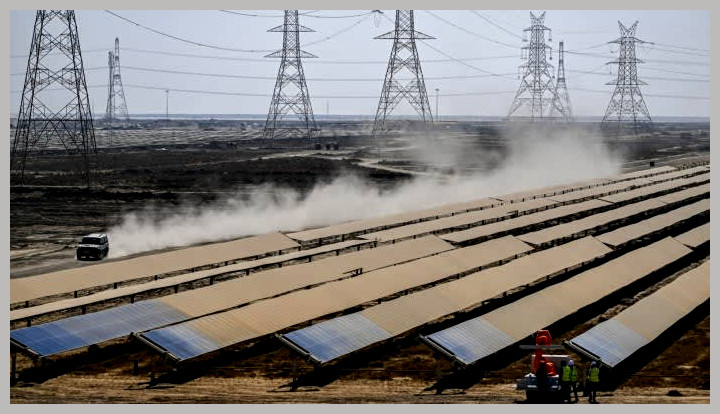
In a rapidly evolving landscape, Indian enterprises are scrambling to seize the opportunities carved out by the ongoing dissolution of Chinese exports within the burgeoning US solar sector. As Washington tightens its grip on manufacturers linked to Beijing, the stage is set for a dramatic reshaping of supply chains in renewable energy.
Sumant Sinha, the visionary at the helm of ReNew—one of India’s titans in the renewable energy arena—asserted in an interview that “there will be demand” for Indian solar components. This assertion is rooted in the United States’ pivot away from Chinese dependencies, as the nation embarks on a critical energy transition. “Diversification is essential, and India stands poised to emerge as the essential complement to China in the green tech supply chain,” he elaborated.
ReNew is already contemplating exports to the US from its Indian solar manufacturing facilities, contingent on the evolving landscape of US tariff regulations. “India is ready to step in and fill the void,” he declared with confidence.
Meanwhile, Washington is deliberating imposing additional tariffs on solar imports, aiming to protect domestic manufacturers following an inundation of Chinese panels that have driven global prices to unprecedented lows. The Department of Commerce’s recent data revealed striking preliminary tariff estimates—up to 293 percent—on solar cell exporters from four Southeast Asian nations, where a significant portion of US solar supplies originate, often intertwined with Chinese entities.
This impending tariff decision is compelling developers and manufacturers to cast their nets wider, seeking refuge in markets unscathed by tariff threats. Wood Mackenzie predicts a remarkable surge in solar cell manufacturing outside the dominant strongholds of China and Southeast Asia, with India projected to contribute a staggering 40 percent of this newly established capacity in the coming years.
“There’s a palpable shift—every modular manufacturer in India is contemplating the export frontier,” noted Subrahmanyam Pulipaka, leading the National Solar Energy Federation of India, an influential lobbying initiative that boasts heavyweight members such as Adani Group, Tata Power, and ReNew.
The figures speak for themselves: US imports of Indian solar panels and cells skyrocketed to surpass $1.8 billion last year, a jaw-dropping leap from a mere $250 million the year prior, as highlighted by BloombergNEF.
Building upon this momentum, Indian manufacturers are also venturing into the heart of the US market, spurred by President Joe Biden’s game-changing Inflation Reduction Act which introduced substantial subsidies for domestic production. Waaree and VSK Energy alone pledged over $1 billion each towards manufacturing commitments just last year.
“The undeniable edge? They’re not Chinese,” affirmed Martin Pochtaruk, who oversees Heliene, a solar panel manufacturer in Minnesota. Transitioning from suppliers in Vietnam and Malaysia, Heliene now sources the bulk of its cells from India to sidestep the stigma of new tariffs. In a bold move, they recently announced a $150 million joint venture with Premier Energies, India’s second-largest solar cell manufacturer, to establish a production facility in the US.
Additionally, the Biden administration has fortified its defenses against solar imports intricately tied to Chinese interests. They’ve escalated duty rates on Chinese cells, introduced anti-circumvention tariffs on Southeast Asian companies, and enacted a ban on products linked to forced labor in Xinjiang. Despite these measures, US imports of solar panels soar to record heights, while several manufacturers, including VSK Energy, have retracted their plans for US production, despite federal tax incentives.
“Clearly, the tariffs haven’t yielded the intended results,” remarked Pol Lezcano, a senior analyst at BloombergNEF. “Manufacturers remain hesitant to establish themselves in the US. The business climate and supply chain dynamics simply aren’t conducive for scaling operations here.”
As prices for imported panels plummet, solar energy continues to ascend as the leading source of new power in the US grid, with the Energy Information Administration forecasting a 42 percent growth in solar installations this year, aiming for a notable 127 gigawatts of capacity.
In a proactive response, leading US solar manufacturers—First Solar and Qcells—have lodged a petition aimed at levying tariffs on solar cells from four Southeast Asian nations to safeguard their beleaguered domestic industry.
Luigi Resta, president of rPlus Energies, voiced concerns that such tariffs could decelerate deployment rates and inflate prices for consumers. He disclosed that his company is exploring supply routes from Indonesia, a nascent market in solar manufacturing, as a hedge against trade turbulence. “Our industry demands agility,” Resta acknowledged, sharing that they currently source around 1GW of panels from both Indonesia and Vietnam.
Navigating these turbulent waters, executives and analysts harbor trepidations that the US government may adopt a game of “Whac-A-Mole” with tariffs, potentially penalizing nations that emerge as manufacturing refuges, thereby threatening billions in capital investments. “If too many players converge on a single location, it undermines the entire sector,” cautioned Jim Wood, CEO of SEG Solar. His company just broke ground on a remarkable $500 million factory near Jakarta, aiming to provide essential cells to its panel production site in Texas.
In these tumultuous times, the US solar industry stands at a crossroads, and it is precisely amid this convergence of strategic pivots that India seeks to carve its substantial niche in the global renewable energy realm.