

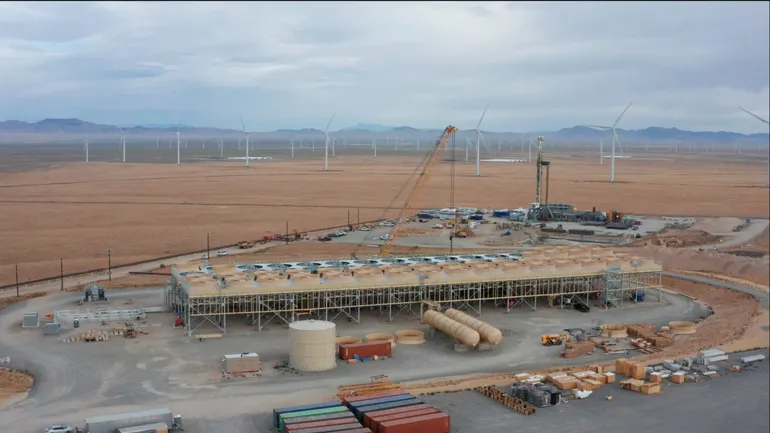
Fervo Energy, a developer in the enhanced geothermal sector, has received mostly positive feedback from early investors after its public debut last month. However, a recent report from Jefferies highlights that the company’s ambitious aim of generating about 42 GW could face challenges due to transmission issues in the Western U.S.
According to Jefferies equity analyst Julien Dumoulin-Smith, these transmission constraints might slow down Fervo’s planned operations, especially since many of their sites are located in rural regions with limited infrastructure. He mentioned that management has recognized this as a potential risk for their full 384 MW capacity, suggesting that behind-the-meter solutions could be part of their strategy.
Likewise, a report from MLQ.ai echoed these concerns in early May, stating that Fervo is dependent on third-party transmission networks for its current operations and revenue generation through power purchase agreements. The company holds about 290 MW in transmission rights for the Cape Station Phase II, which falls short of the required capacity to meet its full contract obligations. Without secured transmission capacity, Fervo may see a decline in revenue or have to adapt its contracts.
On a more optimistic note, Dumoulin-Smith expressed that Fervo’s management team seems more confident than expected about connecting their power generation directly to customers behind the meter, a concept that is gaining traction, according to Sarah Jewett from Fervo.
Fervo has also engaged with the California Public Utilities Commission (CPUC) regarding the need for urgent actions to enhance transmission capabilities as they work on integrating clean geothermal resources.
Fervo’s extensive pipeline spans ten projects primarily located in Nevada, Utah, and Idaho, with additional potential sites identified in California, New Mexico, and Washington.
Investor engagement appears strong, with questions about the unique aspects of enhanced geothermal projects. Dumoulin-Smith noted that while growth is promising, the coming months will be crucial as investor concern will escalate, particularly regarding the execution of their first project, Cape Station, which is scheduled to start commercial operations later this year.
While Cape Station aims to deliver an initial 100 MW of power, it faced a minor setback with a well blowout incident recently. Fortunately, no injuries or environmental harm were reported, and Fervo has assured that the project timeline remains intact.
Nevertheless, Dumoulin-Smith remarked that this incident has heightened investor anxiety, reflecting the critical importance of the project’s near-term execution for Fervo’s stock performance.