

Key Highlights:
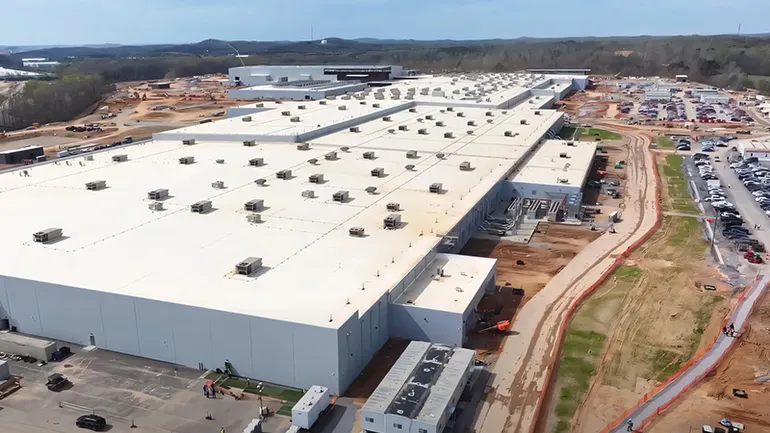
- Qcells has secured a loan guarantee of $1.45 billion from the Energy Department to enhance its solar panel manufacturing plant located in Cartersville, Georgia.
- The new facility is anticipated to create approximately 1,650 full-time positions and produce 3.3 gigawatts (GW) of solar panels every year, which will be sufficient to power around 500,000 homes and cut down carbon dioxide emissions by over five million tons annually.
- Initial production at the Cartersville site began in the spring, with full operations expected to kick off in 2025.
Insight on the Project:
This state-of-the-art facility will manufacture solar components, effectively building a complete supply chain that includes ingots, wafers, solar cells, and final solar panels. According to the Department of Energy, it will be the largest ingot and wafer production plant ever constructed in the United States.
The factory’s projected sales are expected to exceed $2 billion. Additionally, Qcells can take advantage of incentives from the Inflation Reduction Act, notably the Section 45X Advanced Manufacturing Production Tax Credit.
The Cartersville plant will cater to both distributed and utility-scale solar projects. Earlier this year, Qcells entered into an eight-year partnership to supply 12 GW of solar energy to Microsoft, utilizing panels produced at this facility.
Not far from Cartersville, Hanwha Qcells USA, Inc. established another solar factory in Dalton, Georgia, in 2019. Hanwha, the parent company of Qcells, expanded this Dalton facility in October 2023, pushing its production capacity to 5.1 GW of solar panels each year.
Qcells is investing about $2.8 billion to establish a comprehensive and sustainable solar supply chain in the U.S. This initiative was first announced in January 2023. So far, Hanwha Qcells USA has completed over 2 GW of projects with an additional 10 GW in the pipeline.
The Biden-Harris administration has been focused on finalizing clean energy loans through the Energy Department during the current presidential term. By November 2024, the Loan Programs Office reported receiving 210 applications for domestic clean energy projects, amounting to more than $324.3 billion in requested loans and guarantees.
Recent projects funded by the DOE include a notable $9.63 billion loan to BlueOval SK to enhance electric vehicle battery production and a $1.25 billion loan to EVgo aimed at expanding public fast charging facilities across the United States.