

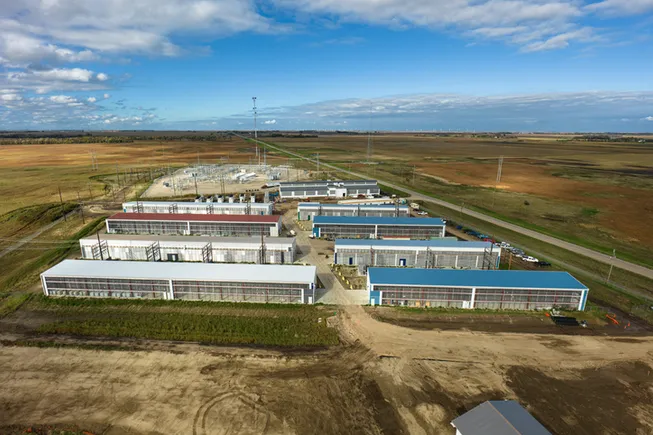
The U.S. Department of Energy (DOE) has selected 16 federal sites as potential locations for new data centers and energy resources. On Thursday, the DOE released a request for information (RFI) inviting feedback from stakeholders, including grid operators, regarding these upcoming projects, which could be operational in less than two years.
“The race to lead in artificial intelligence is like a new Manhattan Project. With President Trump’s leadership and the innovation from our National Labs, the U.S. can win this race,” said Energy Secretary Chris Wright. He added that the DOE is taking crucial steps to harness domestic resources to fuel the AI revolution.
Currently, data centers are responsible for about 4.5% of electricity use in the U.S., but projections show this could climb to 12% by 2028, according to a recent report from the Southwest Energy Efficiency Project.
This RFI aligns with the plans announced by Trump in January, which aim to fast-track the development of power plants for AI data centers under an energy emergency declaration. It echoes an executive order signed by former President Biden earlier this year, which focused on clean energy-powered AI data centers, though the current RFI does not specify the use of clean energy for the new facilities.
Responses to the RFI are due within 30 days of its publication in the Federal Register. The DOE aims to gauge industry interest in building, operating, and maintaining AI infrastructure on its lands, as well as gather information on development strategies, technologies, operational methods, and economic factors. They are also interested in insights from energy grid operators on the existing energy infrastructure and the possibility of combining data centers with new energy generation.
The RFI explores various topics, including the power requirements of these data centers, timelines, and strategies for co-locating energy sources. The DOE has set a target for construction to begin by the end of this year, aiming for operations to start by the end of 2027.
The RFI provides details on the hosting capacity of the selected sites. For instance, the Flatiron Campus at the National Renewable Energy Laboratory has sufficient land, power, water, and broadband capabilities to support a 100 MW data center, with the potential to begin operations as soon as this year. The Argonne National Laboratory is also considered a suitable site for a future 1,000 MW AI data park, with operations targeted to commence by 2028.
Other locations mentioned in the RFI include: Idaho National Laboratory; Paducah Gaseous Diffusion Plant; Portsmouth Gaseous Diffusion Plant; Brookhaven National Laboratory; Fermi National Accelerator Laboratory; National Energy Technology Laboratory; Oak Ridge National Laboratory; Pacific Northwest National Laboratory; Princeton Plasma Physics Laboratory; Los Alamos National Laboratory; Sandia National Laboratories; Savannah River Site; Pantex Plant; and Kansas City National Security Campus.